
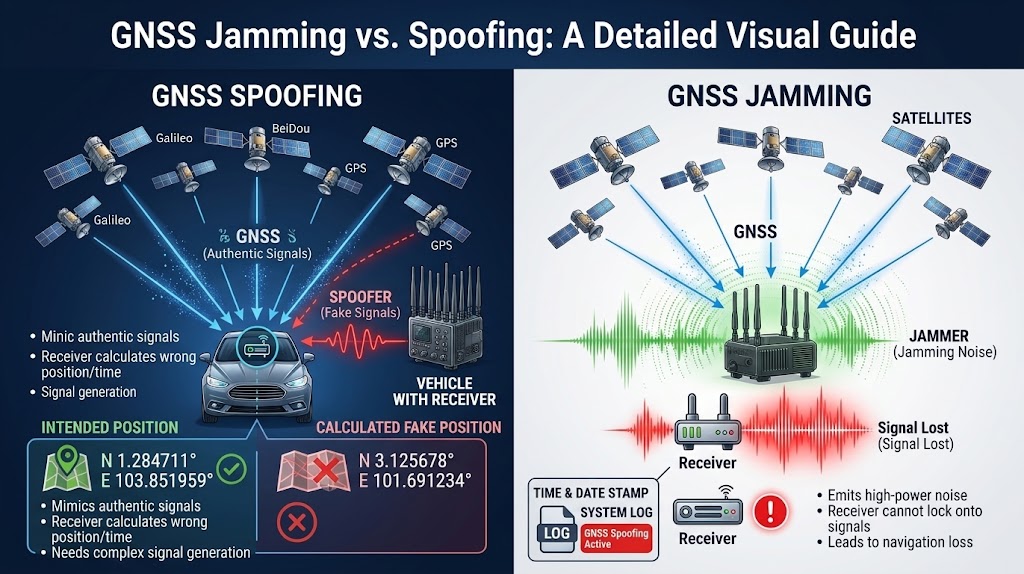
Global Navigation Satellite System (GNSS) signals are weak—around −130 dBm at the ground, far below the radio noise floor. That single fact explains both major threats: jamming and spoofing. They are constantly mentioned together, yet they work in opposite directions and need different defenses. This guide disentangles them and shows how to tell which one is hitting you.
What Is GNSS Jamming?
Jamming is the blunt instrument. A jammer transmits loud radio noise on the GNSS bands (for example GPS L1 at 1575.42 MHz, L2, L5—see our frequency band guide). Because interference is stronger than the satellite signal reaching the receiver, the receiver loses lock and stops producing a fix.
Representative ranges: a handheld jammer at 1–10 W EIRP can deny GPS over tens to hundreds of meters; vehicle-mounted or fixed installations reach kilometers. The attack goal is simple—deny the signal, not fake it.
What Is GNSS Spoofing?
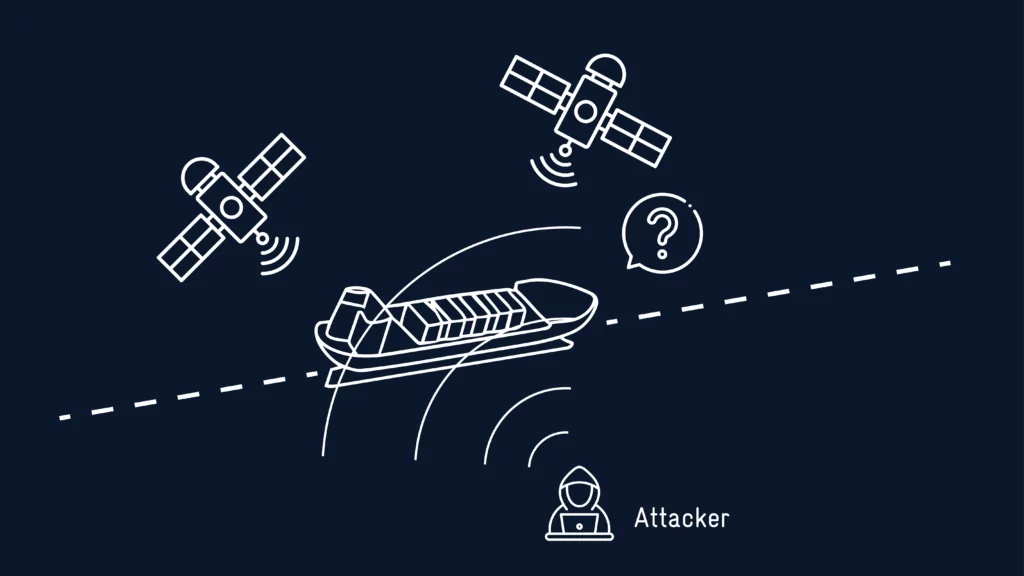
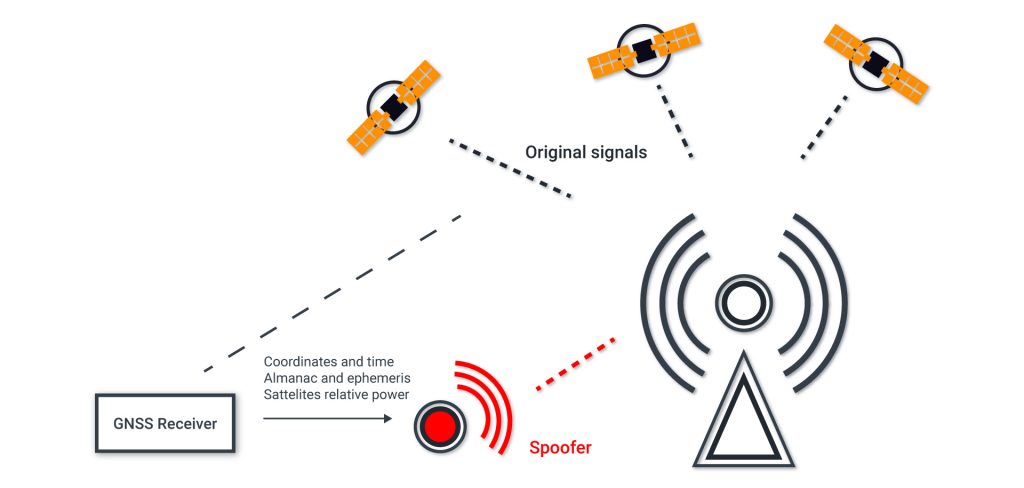
Spoofing is subtler. Instead of drowning the signal, a spoofer transmits false but convincing GNSS signals that report a wrong position or time. The receiver trusts them and is silently misled—a vessel “teleported,” a drone redirected. Spoofing is harder to notice because the navigation output still looks normal, and the spoofer only needs to be stronger than the real signal at the victim’s antenna.
Jamming vs Spoofing: Side-by-Side
| Dimension | Jamming | Spoofing |
|---|---|---|
| Attacker intent | Block the signal | Feed false data |
| Receiver output | Loses fix / freezes | Shows wrong position or time |
| How to spot it | Obvious, immediate | Often silent |
| Primary defense | Spatial nulling (CRPA) | Authentication + sensor fusion |
| Typical source | Cheap trackers, denial systems | Dedicated transmitters, replay devices |
How to Tell If You’re Jammed or Spoofed
Field symptoms separate the two quickly:
| Symptom | Likely cause |
|---|---|
| Every device in the area loses GPS at once | Jamming |
| Position jumps to 0,0 or drifts smoothly away | Spoofing (or severe multipath) |
| CNR collapses on all satellites simultaneously | Jamming |
| All satellites show improbably high signal strength | Spoofing |
| Time/logging breaks while position looks fine | Spoofing (time attack) |
For step-by-step detection methods and the exact metrics to watch, see how to detect GNSS jamming and spoofing.
Why Both Threats Show Up Together
In contested regions, operators routinely see jamming and spoofing running at the same time. A resilient design cannot assume only one. That is why anti-jamming and anti-spoofing are increasingly delivered as one assured-PNT stack—covered in do you need both?
Defense Mapping
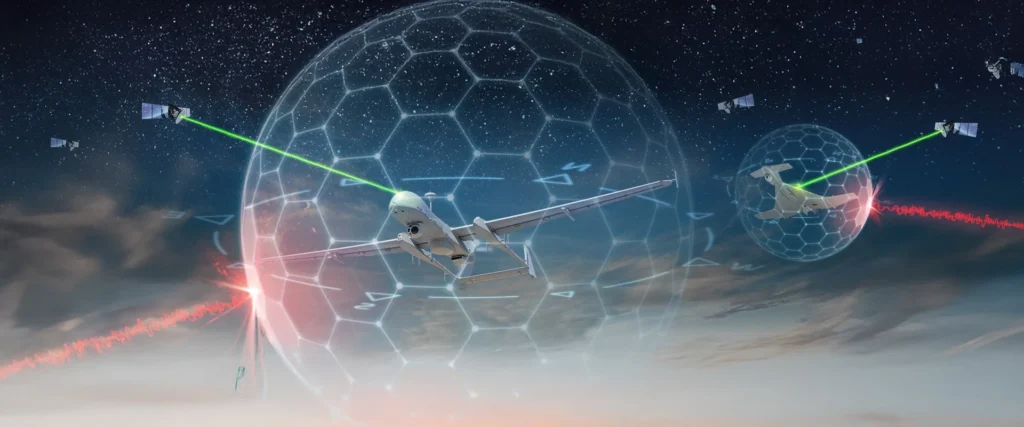
- Against jamming: a CRPA antenna with adaptive nulling places spatial nulls on the noise.
- Against spoofing: cryptographic authentication (Galileo OSNMA, GPS Chimera) and consistency checks against inertial sensors verify the signal is genuine.
- Against both: an integrated protected receiver pairs nulling with verification—explored in anti-jamming technologies and military-grade systems mapping to commercial use.
FAQ
Q: Is jamming or spoofing more dangerous?
A: Spoofing is generally more dangerous because it deceives silently; jamming is obvious. Both need dedicated countermeasures.
Q: Can a regular GPS antenna stop either?
A: No. A standard single-element antenna has no spatial filtering or authentication. Only array-based antennas and verified receivers help.
Q: Could my problem just be a bad signal, not an attack?
A: Possibly—see why GPS suddenly stops working to rule out environment and hardware first.