
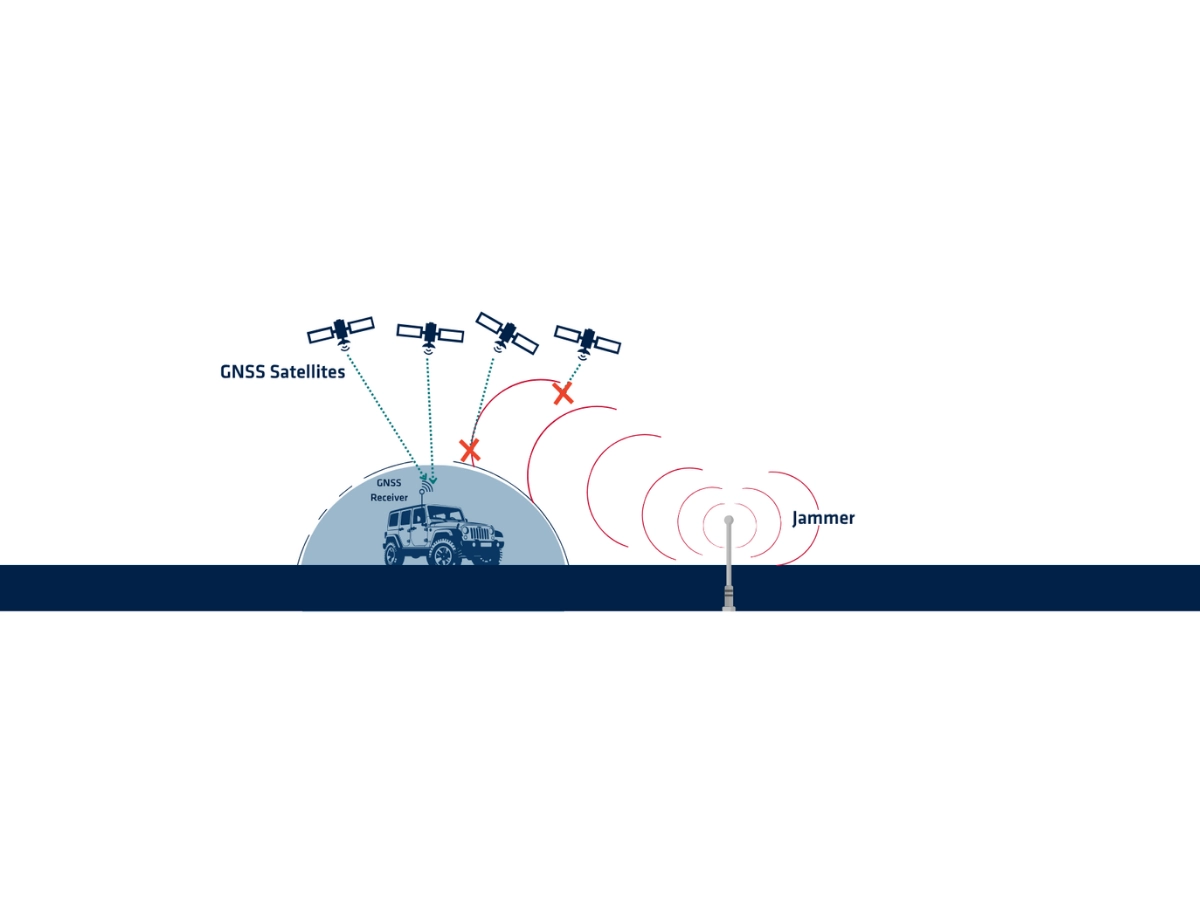
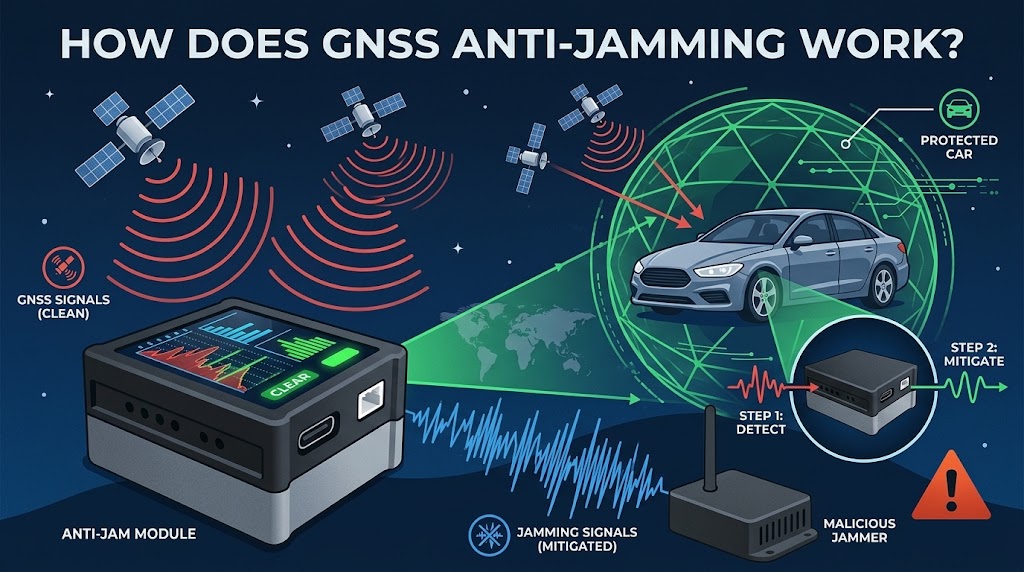
Protecting GNSS means fighting physics: the satellite signal is tiny (−130 dBm) and any local noise source can overwhelm it. Anti-jamming technology restores the balance using antennas, signal processing, and verification. This is the technical pillar—a comparison of the major techniques by performance, cost, and fit.
Why GNSS Needs Active Protection
Because GNSS arrives far below the noise floor, once RF interference enters a single-element antenna, software cannot recover the buried signal. Protection must happen at the antenna or in the receiver front end. That is the dividing line between techniques that work and those that don’t.
Technique Comparison
| Technique | Typical J/S gain (or capability) | Relative cost | Complexity | Primary Threat Addressed |
|---|---|---|---|---|
| Spatial nulling (CRPA) | 20–60 dB | High | High | Strong, sustained jamming |
| Nulling receiver (digital) | 10–25 dB | Medium | Medium | Moderate commercial threats |
| Front-end filtering / notch | 5–15 dB | Low | Low | Narrowband / known interferers |
| Multi-constellation & frequency diversity | 3–10 dB | Low | Low | Signal resilience, not hard denial |
| INS / odometry fusion | (Bridges total loss) | Medium | Medium | Bridging GNSS outages |
| Signal authentication | (Detects spoofing) | Low–Med | Medium | Spoofing detection & rejection |
CRPA and Adaptive Nulling – The Gold Standard
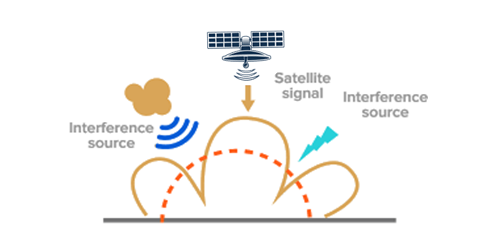
A Controlled Reception Pattern Antenna (CRPA) utilizes multiple discrete antenna elements combined with sophisticated adaptive digital beamforming algorithms. The system continuously calculates the angle of arrival of incoming interference and digitally steers “nulls” (areas of near-zero gain) directly toward the jammer, while simultaneously maintaining high-gain beams toward legitimate GNSS satellites. This spatial filtering provides exceptional performance against strong, broadband, and sustained jamming attacks, making it the definitive foundation for military-grade and high-assurance commercial avionics. When properly designed with 4 to 8 elements, it achieves adaptive nulling depths of 30–60 dB, neutralizing multiple simultaneous threats from varying azimuths and elevations.
Filtering and Notch Techniques – Cost-Effective Front-End Defense
SAW filters and adaptive notch filters at the RF front-end provide a lightweight, low-cost first layer of defense by physically blocking specific known narrowband frequencies before they reach the digital processor. While they effectively eliminate out-of-band emissions and single-tone continuous-wave jammers, they possess inherent limitations: they cannot handle wideband, swept-frequency, or high-power jammers. Therefore, these techniques are best deployed as a supplementary layer within a comprehensive CRPA system, rather than as a standalone solution.
Multi-Constellation and Frequency Diversity – Distributing the Risk
Modern receivers simultaneously track GPS, Galileo, BeiDou, and GLONASS across multiple bands (L1/L2/L5, E1/E5, B1C). By leveraging frequency and constellation diversity, the system gains inherent robustness against narrowband interference and line-of-sight occlusions. A jammer targeting GPS L1, for instance, will not compromise signals on the Galileo E5 or BeiDou B1C bands. This approach significantly improves resilience against non-malicious RF noise and urban canyon effects. However, it remains vulnerable to a dedicated broadband high-power jammer, necessitating integration with spatial nulling for operation in contested environments.
Sensor Fusion (INS) – Bridging GNSS Outages
Inertial Navigation Systems (INS), relying on high-grade gyroscopes and accelerometers, provide precise dead-reckoning that seamlessly bridges brief or total GNSS outages. In a tightly-coupled architecture, the INS continuously cross-calibrates with the GNSS receiver, enabling uninterrupted position, velocity, and attitude propagation when the RF signal is lost. It is crucial to recognize that INS inherently accumulates drift over time without external corrections; thus, it serves as a complementary bridging mechanism rather than a replacement for active anti-jamming hardware.
Choosing a Stack by Threat Level
Selecting the optimal protective solution depends strictly on the anticipated RF threat environment:
- Incidental noise & weak signal conditions (e.g., urban multipath, out-of-band emissions): Multi-constellation diversity combined with front-end filtering is sufficient to maintain lock retention in benign environments.
- Moderate commercial jamming (e.g., localized handheld jammers): A digital nulling receiver paired with basic INS fusion provides robust defense against limited, non-military interference.
- Strong, sustained denial & electronic warfare (e.g., military operational zones): This requires a fully integrated Assured-PNT stack—a multi-element CRPA array (4 to 8 elements) providing deep spatial nulling, tightly-coupled INS for seamless bridging, and cryptographic signal authentication to defeat spoofing.
- Next Steps: For a detailed assessment tailored to your specific mission profile, browse our aviation and tactical-grade hardware catalog, or consult with our team regarding export compliance and regional availability.

FAQ
Q: Is CRPA the only option?
A: It is the most effective for hard jamming, but nulling receivers and fusion help at lower threat levels and cost.
Q: Can software alone stop jamming?
A: No. Once noise enters a single-element antenna, the signal is buried; antenna-level nulling is required.
Q: Does anti-jamming also fix spoofing?
A: Partially. Nulling helps against some spoofers, but dedicated authentication is usually needed too.