
By Dr. Helena Voss, Principal RF Engineer at NavShield Global (15 years in adaptive-antenna and PNT protection design).
Technical review by the NavShield RF Engineering Team.
Global Navigation Satellite System (GNSS) signals reach the Earth’s surface at roughly a billionth of a watch battery’s strength — quieter than ambient thermal noise. That physical vulnerability is why a CRPA antenna (Controlled Reception Pattern Antenna) is essential: it is the primary hardware defense against high-power intentional GNSS jamming.
This guide breaks down what is CRPA, how it operates, how a CRPA GPS setup compares to a standard passive antenna, and how the controlled reception pattern antenna market is evolving across low-altitude UAVs, ground transport, and critical infrastructure.
What Is a CRPA Antenna and How Does It Work?
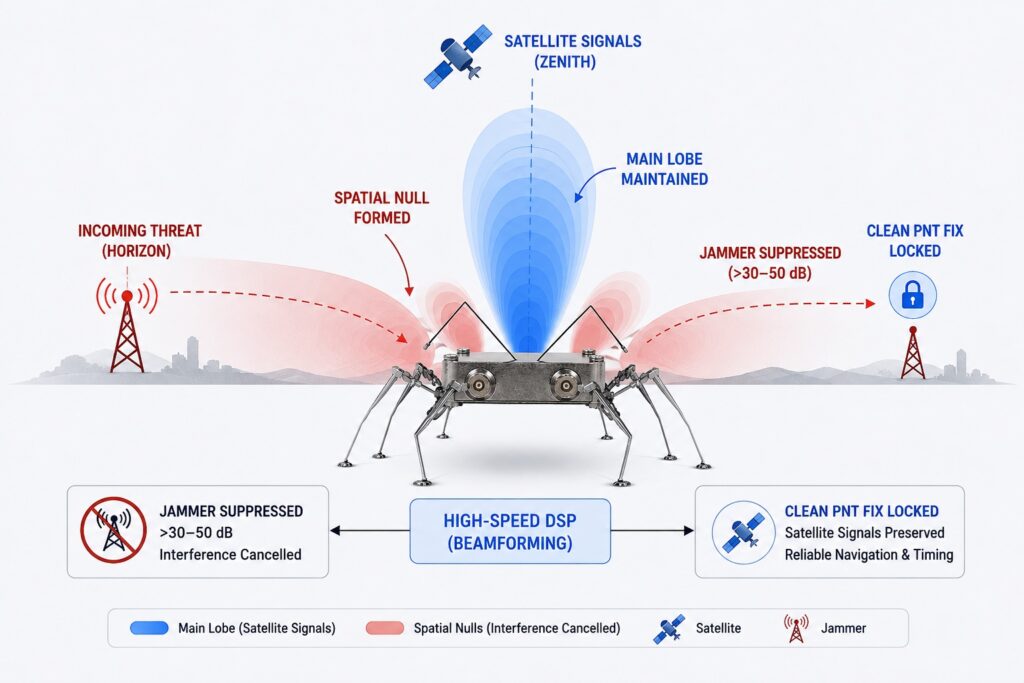
A controlled reception pattern antenna (CRPA) integrates a multi-element antenna array with high-speed digital signal processing (DSP). Unlike conventional omnidirectional antennas that receive radio energy equally from all angles, a CRPA dynamically modifies its reception pattern in real time to cancel interference while preserving genuine satellite signals.
Incoming Threat (Horizon)  ──► [ Spatial Null Formed ] ──► Jammer Suppressed (>30–50 dB)
Satellite Signals (Zenith) ──► [ Main Lobe Maintained ] ──► Clean PNT Fix Locked
1. The Multi-Element Antenna Array
A CRPA contains multiple localized antenna elements (typically 2, 4, or 8) arranged in a precise geometric layout. Because the elements are spatially separated, incoming RF waveforms arrive at each element with slight phase and time differences. This spatial diversity allows the digital processor to distinguish wanted satellite signals overhead from hostile jamming signals near the horizon.
2. Adaptive Space-Time Beamforming
The internal beamformer applies complex mathematical weights (amplitude and phase adjustments) to each element’s digitized output before summing them. By continuously resolving space-time adaptive algorithms, the array steers high gain toward authentic satellites while generating deep attenuation notches toward interference vectors.
3. Real-Time Null Steering
A “null” is a sharp drop in antenna sensitivity in a specific direction. While a standard patch antenna is overwhelmed by broadband RF noise, an adaptive null-steering array drops 30 dB to >50 dB of attenuation directly onto the jammer’s line of sight, preventing receiver saturation and loss-of-lock.
CRPA GPS vs. Regular GPS Antenna: Side-by-Side Comparison
The fundamental distinction between a CRPA GPS configuration and a standard passive GPS antenna is active spatial adaptivity. A standard antenna functions like an open microphone; a CRPA functions like directional noise-canceling hardware focused entirely on silencing the noise source.
| Technical Aspect | Regular Passive GPS Antenna | Adaptive CRPA GPS Array |
| Element Architecture | Single passive patch element | 2 / 4 / 8 active multi-element array |
| Interference Response | Blinded / Loses lock under RF noise | Dynamically steers nulls; preserves tracking |
| Spatial Awareness | Omnidirectional (Fixed hemispherical) | Jammer-aware (Adaptive radiation pattern) |
| Nulling Capability | 0 dB (No interference suppression) | >30 dB to >50 dB per threat direction |
| Target Integration | Consumer electronics, benign environments | Commercial UAVs, defense platforms, critical grids |
| Form Factor & Complexity | Ultra-compact, low cost | Scaled size and weight; requires multi-channel RF front-end |
Configuration Sizing: How Many Elements Do You Need?
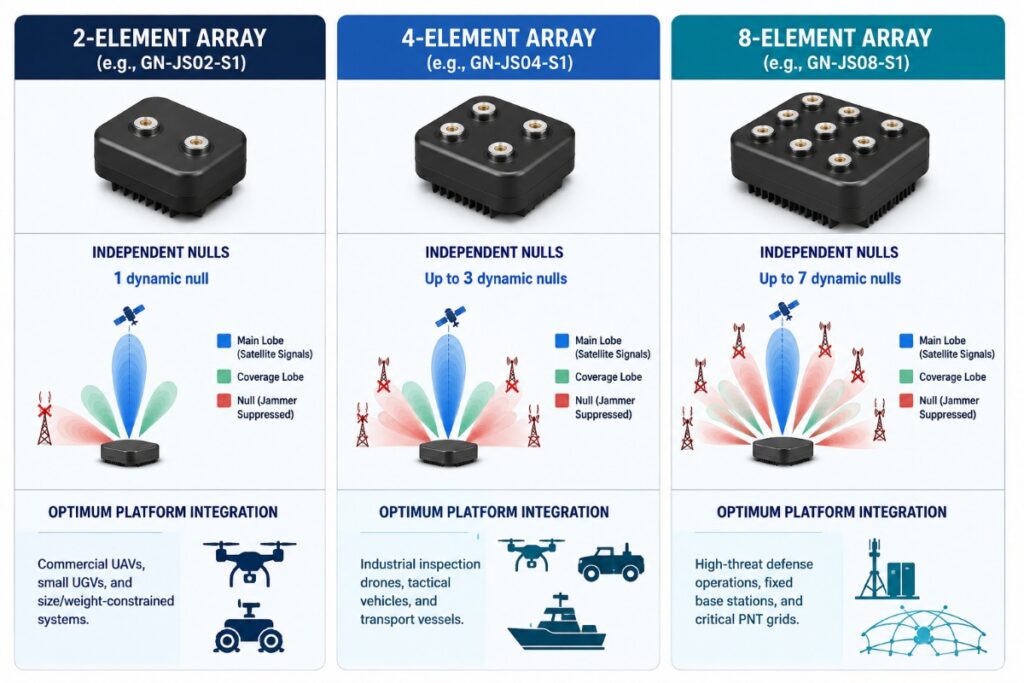
The number of array elements determines how many independent jamming sources the system can suppress simultaneously ($N-1$ rule for an $N$-element array). Selecting the correct configuration requires balancing spatial resilience against platform size, weight, power, and cost (SWaP-C).
| Configuration | Independent Nulls | Optimum Platform Integration |
| 2-Element Array (e.g., GN-JS02-S1) | 1 dynamic null | Commercial UAVs, small UGVs, and size/weight-constrained systems. |
| 4-Element Array (e.g., GN-JS04-S1) | Up to 3 dynamic nulls | Industrial inspection drones, tactical vehicles, and transport vessels. |
| 8-Element Array (e.g., GN-JS08-S1) | Up to 7 dynamic nulls | High-threat defense operations, fixed base stations, and critical PNT grids. |
Multi-Constellation Frequency Bands & CRPA Performance
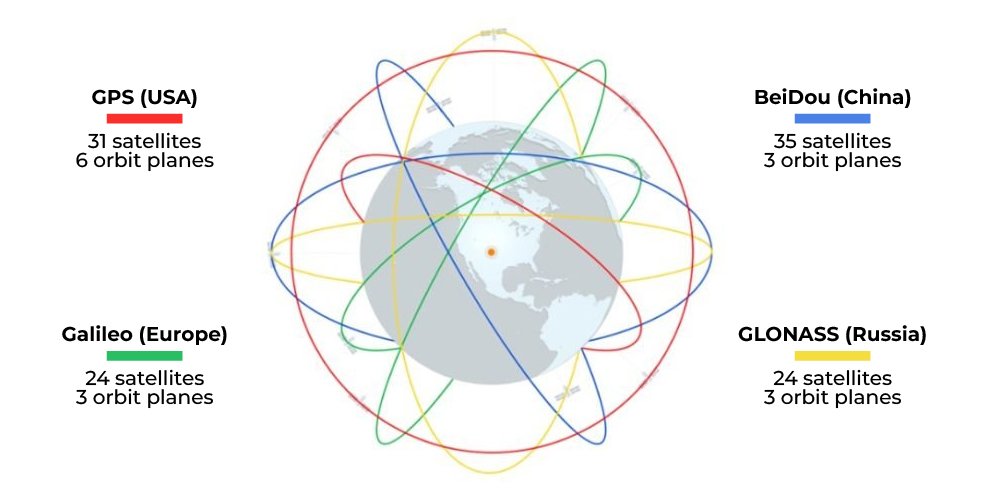
An adaptive array can only protect the specific RF spectrum it is tuned to capture. Wideband jammers frequently target both upper and lower L-bands simultaneously.
To prevent loss-of-fix, modern CRPA hardware must support multi-constellation, multi-frequency channels:
- GPS: L1 (1575.42 MHz), L2 (1227.60 MHz), L5 (1176.45 MHz)
- BeiDou (BDS): B1I (1561.098 MHz), B1C (1575.42 MHz), B2a (1176.45 MHz), B3I (1268.52 MHz)
- Galileo: E1 (1575.42 MHz), E5a (1176.45 MHz), E5b (1207.14 MHz), E6 (1278.75 MHz)
- GLONASS: G1 (1602 MHz), G2 (1246 MHz), G3 (1202.025 MHz)
Does a CRPA Antenna Protect Against GPS Spoofing?
Jamming and spoofing are different threats. Jamming is RF overpower — CRPA nulls it directly. Spoofing is signal deception — CRPA may attenuate an off-angle spoofer but cannot reliably authenticate civil GPS signals. For spoofing protection, pair the CRPA with a dedicated GNSS spoofing detector that validates C/N₀ consistency, code-carrier alignment, and ephemeris plausibility before the receiver trusts the data.
CRPA Applications: Where Adaptive Nulling Matters Today
Once reserved for military aviation and naval platforms, CRPA adoption is now expanding across commercial and industrial sectors where GNSS denial directly impacts operational safety and continuity:
- Low-altitude UAV operations — Delivery drones and inspection UAS face increasing risks from consumer-grade jammers at distribution hubs and perimeters.
- Autonomous ground vehicles — Robotic trucks and port AGVs rely on continuous GNSS fix for lane-level positioning in dense logistics corridors with uncontrolled RF interference.
- Critical infrastructure timing — Power grids and 5G backhaul networks use GNSS as primary time synchronization source; even brief signal loss can cascade into synchronization failures.
- Maritime autonomous navigation — Commercial vessels in congested shipping lanes encounter both accidental radar/GNSS band overlap and targeted port-side jamming.
- Surveying and precision agriculture — High-value field operations demand uninterrupted centimeter-level accuracy during narrow seasonal windows; RF disruptions translate directly to operational delays and revenue loss.
These applications share a common requirement: lightweight, multi-frequency CRPA modules that integrate with existing autopilots and GNSS receivers without major platform redesign.
Key Engineering Takeaway: A CRPA is a spatial filter, not a cryptographic authenticator. Deploy it for jamming immunity; pair it with a spoofing detector for cyber integrity. And when evaluating market offerings, prioritize SWaP-optimized, tri-band-capable arrays with integrated beamforming DSP — because the threat landscape is evolving faster than most procurement cycles can follow.