
Engineering GPS Security
That Never Fails
Four technology pillars working in unison to protect your GNSS reception against the most sophisticated jamming and spoofing attacks.
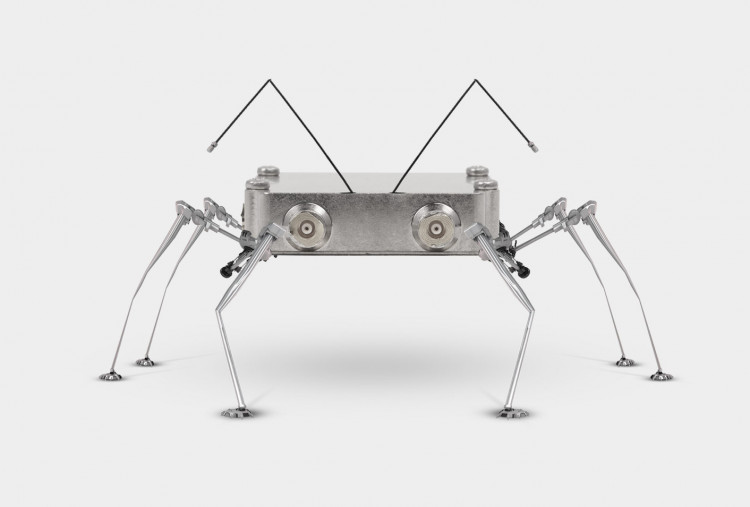

Software Defined Radio Engine
A fully programmable SDR architecture that lets us adapt to new threats via firmware updates—no hardware replacement needed.
- FPGA-based digital signal processing pipeline
- Real-time spectrum analysis and threat classification
- Field-upgradable algorithms via secure OTA updates
- <2W typical power consumption
Future-proof protection that evolves with the threat landscape.
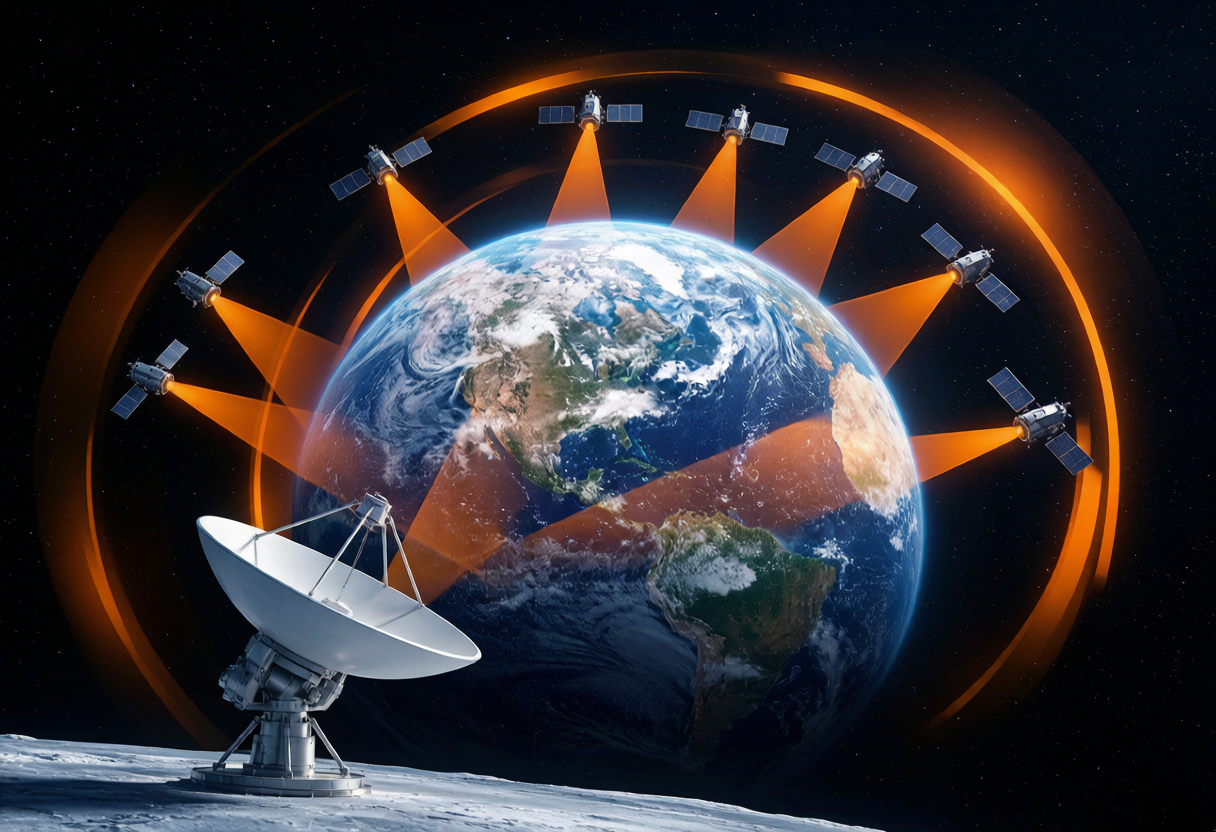
Multi-Constellation GNSS Receiver
Simultaneous tracking of four global navigation satellite systems for maximum coverage redundancy and positioning accuracy.
- GPS L1/L2 + GLONASS L1/L2 + Galileo E1/E5a + BeiDou B1I/B2a
- 224-channel parallel tracking across all constellations
- Automatic constellation health monitoring and failover
- RTK-capable for centimeter-level positioning accuracy
- Safety-of-life certified receiver core
If one constellation is compromised, others keep you on course.
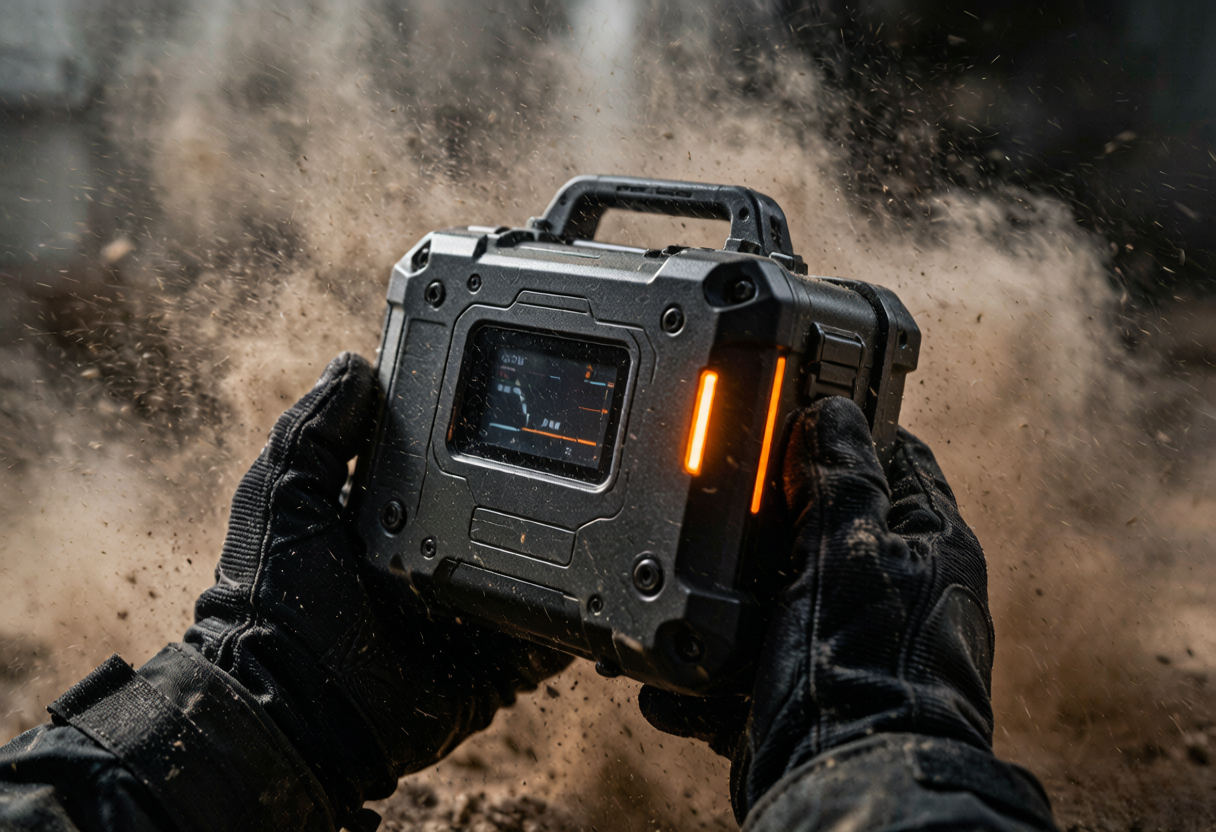
Industrial-Grade Environmental Hardening
Built to operate where consumer electronics fail. Every component is tested beyond standard rigorous environmental standards.
- IP67 sealed enclosure — dust-tight, waterproof to 1m submersion
- -40°C to +71°C operating temperature range
- compliant with international shock, vibration, and altitude
- Conformal coating on all PCB assemblies
From desert heat to arctic cold — it just works.
How It Works — Four Steps to Signal Integrity
Detect
Continuous RF spectrum monitoring identifies interference signatures in <100 ms, with advanced arrays classifying and nulling threats in <20 ms.
Analyze
SDR engine classifies threat type, direction of arrival, power level, and modulation characteristics.
Null
CRPA array steers deep nulls toward interference sources while preserving satellite signal paths.
Output
Clean, authenticated GNSS data feeds your navigation system with zero perceptible interruption.
GNSS Anti-Jamming Techniques
How controlled-reception-pattern arrays and adaptive signal processing keep your position lock alive in contested RF environments.
Adaptive Nulling
A CRPA anti-jammer steers deep nulls toward each interference source, cancelling jammer energy while preserving satellite paths — the core GNSS anti-jamming technique behind every NavShield anti-jamming antenna.
Beamforming Gain
Multi-element arrays add beamforming gain on the desired signal, raising the signal-to-interference ratio so an anti-jam GPS antenna keeps lock where single-element antennas fail.
Multi-Constellation Fusion
Cross-checking GPS, GLONASS, BDS and Galileo exposes synthetic signals that single-band receivers accept as real, hardening the receiver against spoofing.
Direction-of-Arrival
Estimating the angle of each interferer lets the array place nulls with precision, scaling protection from a 2-element to an 8-element CRPA as threats multiply.
Technical Specifications
Compare key parameters across our CRPA product line to find the right fit for your platform.
| Parameter | GN-JS02-S1 (Ultra-Light / Mini UAV) | GN-JF04-S2 (Dual-Band / Industrial UAV) | GN-JH08-S3 (Full-Band / Tactical Tier) |
|---|---|---|---|
| Best Fit Application | Micro UAVs, Small UGVs, SWaP-Constrained Drones | Industrial Inspection Drones, Commercial Fleets, UGVs | Tactical Defense, High-Threat Environments, Base Stations |
| Antenna Elements | 2 Elements | 4 Elements | 8 Elements |
| Simultaneous Nulls | 3 Threat Directions | 3 Threat Directions | 7 Threat Directions |
| System Anti-Jam Margin (J/S) | ≥100 dB (Single) / ≥95 dB (3-Jammer) | ≥100 dB (Single) / ≥95 dB (3-Jammer) | ≥110 dB (Single) / ≥105 dB (3-Jammer) |
| Spatial Nulling Depth | 30–40 dB | 40–50 dB | >50 dB |
| Frequency Coverage | L1 / B1 / E1 | L1/B1 + L2/B2b (Dual-Band) | L1/L2/L5 + B1/B2/B3 + E1/E5 (Full-Band) |
| Extended Feature | Integrated Anti-Spoofing (Optional) | Integrated Anti-Spoofing (Optional) | Integrated Anti-Spoofing (Optional) |
| Dimensions (L×W×H) | 60 × 50 × 25 mm | 100 × 100 × 30.5 mm | 175 × 175 × 42 mm |
| Weight | <100 g | <270 g | <750 g |
| Power Consumption | <6 W (12V DC) | <8 W (12V DC) | <24 W (12V DC) |
| Interface Ports | 1×SMA Female, 1×GH1.25-9P | 1×SMA Female, 1×J30J-9ZKP | 1×SMA Female, 1×J30J-9ZKP |
| Operating Temp & IP | −40°C ∼ +70°C / IP67 | −40°C ∼ +70°C / IP67 | −40°C ∼ +70°C / IP67 |
Why Our Technology Leads
Not all anti-interference is created equal. Here’s what sets our approach apart.
Field-Proven
Deployed in demanding operational environments since 2019. Our systems have logged over 2 million operational hours under real interference conditions—not just lab tests.
No Single Point of Failure
Modular architecture means no critical component can disable the entire system. Redundant processing paths ensure continuous operation.
Future-Ready by Design
SDR-based architecture accepts firmware updates for new threat types. QZSS and IRNSS constellation support coming in next release.
Transparent Integration
Drop-in replacement for standard GPS antennas. No changes to your host navigation system required. Standard ARINC/DO- interfaces.
Frequently Asked Questions
What’s the difference between CRPA and a regular GPS antenna?
A standard antenna receives signals from all directions equally—including interference. A CRPA uses multiple antenna elements to create directional “beams” toward satellites while placing “nulls” (blind spots) toward jammers. It’s like switching from an omnidirectional microphone to a directional one that can ignore background noise.
Will this work with my existing GPS receiver?
Yes. Our CRPA systems output standard GPS data formats (NMEA 0183, RTCA DO-260B). To your navigation system, it looks exactly like a high-quality GPS antenna. The anti-interference magic happens transparently inside our unit.
Does it protect against GPS spoofing?
Jamming suppression is our primary defense, but our SDR engine also includes cryptographic authentication checks and signal anomaly detection that flag potential spoofing attempts. For environments with high spoofing risk, we recommend pairing CRPA with our dedicated GNSS Spoofing Detection module.
Which model should I choose?
Match the tier to your platform and threat environment. The GN-JS02-S1 (2-element, <100 g, L1/B1/E1) is the ultra-light choice for micro UAVs and SWaP-constrained drones, with ≥100 dB single-source suppression. The GN-JF04-S2 (4-element, <270 g, L1+L2 dual-band) suits industrial inspection drones, commercial fleets, and UGVs, adding dual-band resilience. The GN-JH08-S3 (8-element, <750 g, full-band L1/L2/L5) is the tactical tier for high-threat defense, base stations, and critical infrastructure, delivering ≥110 dB suppression across 7 simultaneous nulls.
What certifications do your products carry?
All models in the GN-JS / GN-JF / GN-JH series carry CE and FCC certification, are rated IP67, and operate from −40°C to +70°C. The dual-band and full-band tiers add environmental hardening suitable for field and tactical deployment. Custom certification support is available for integration projects.
Match Your Platform to the Right Tier
Not sure between Ultra-Light, Dual-Band, or Full-Band? Talk to our engineering team about platform fit, export requirements, and evaluation units for qualified programs.