
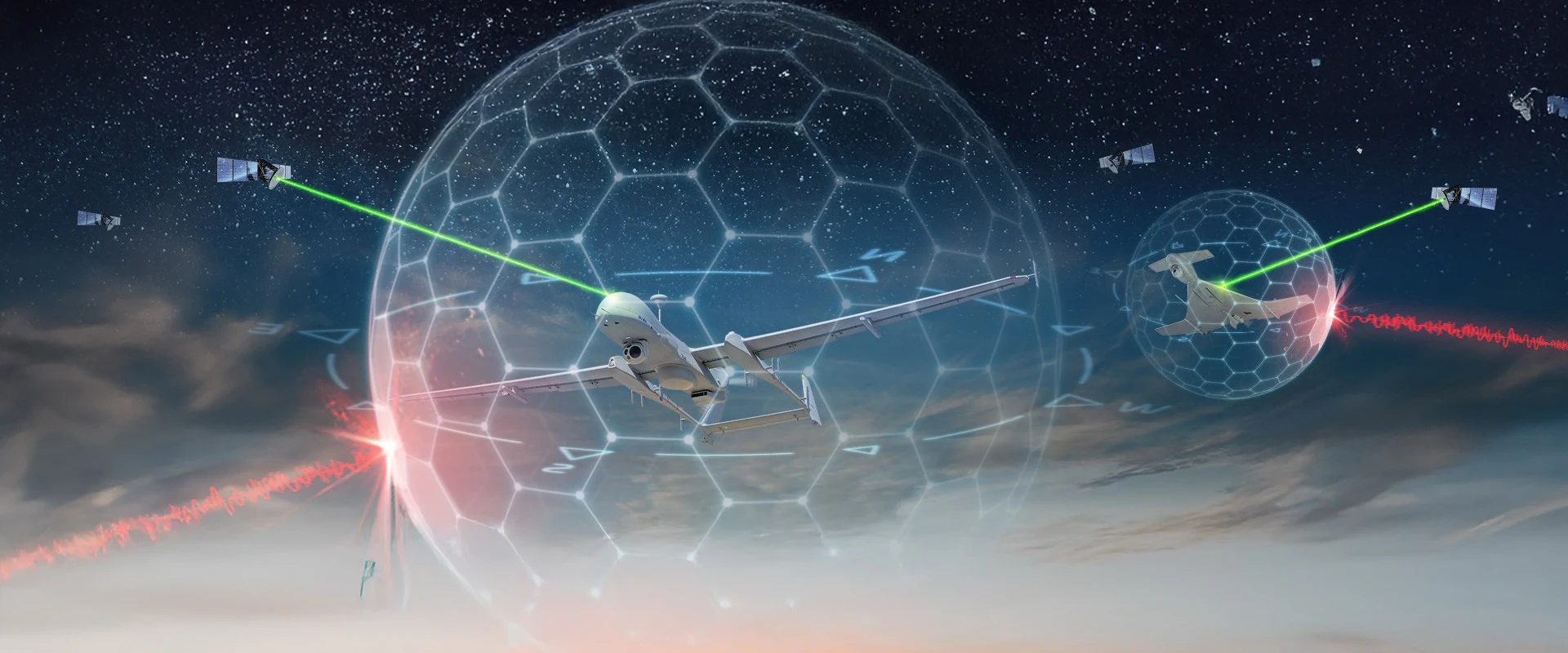
Positioning, navigation, and timing (PNT) are essential components of all operations that rely on Global Navigation Satellite Systems (GNSS). In the event of a large-scale GNSS signal blockade, military countermeasures—including CRPA antennas, adaptive nulling, M-codes, and anti-spoofing techniques—are now also used to protect commercial drones, ships, and critical infrastructure. Let’s understand how these systems actually work and their applications.
What Is a “Contested” GNSS Environment?
The term Contested Environment PNT comes from defense: an operating environment where GPS/GNSS signals are degraded, denied, jammed, or spoofed—forcing platforms to rely on alternative PNT sources like inertial navigation, terrestrial signals, or cooperative network solutions.
In a contested environment you cannot rely on bare GNSS. You need assured PNT—position and time you can trust even when the sky is hostile. That requirement is no longer military-only; drones near airports, ships in busy waterways, and power grids all face it.
CRPA and Adaptive Nulling — The Core Defense
What Is CRPA’s Role in Nulling?
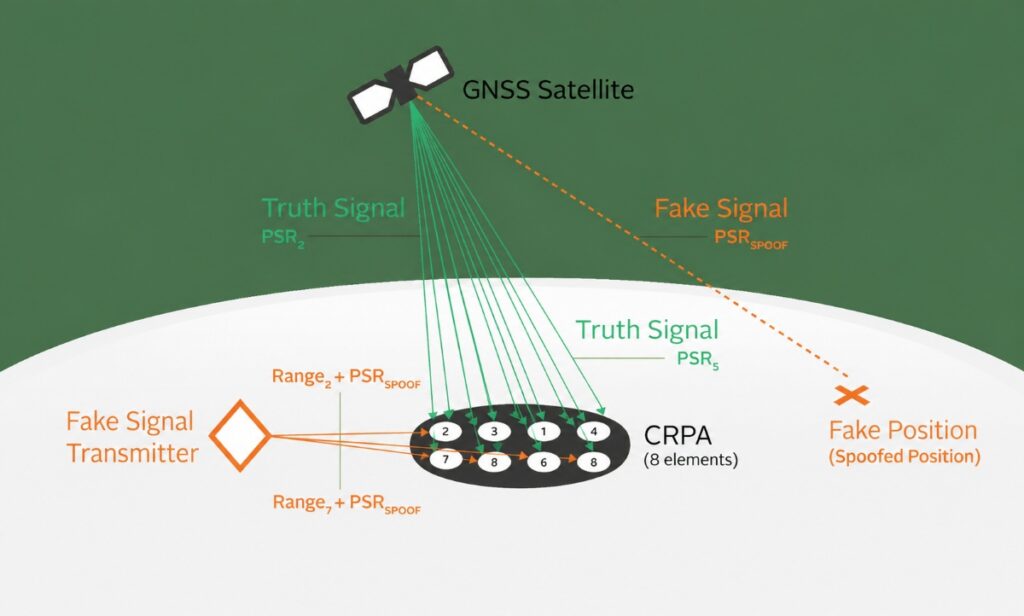
A Controlled Reception Pattern Antenna (CRPA) uses multiple elements—typically 4, 8, or 12—instead of one. Because it knows the geometry of its own elements, it can steer nulls (points of very low reception) toward interference while keeping gain on the satellites it wants. That spatial filtering is the single most effective defense against jamming, and it is the foundation of every modern anti-jamming system.
SMI, LMS, and adaptive beamforming compared
The antenna is only hardware; the intelligence is in the CRPA nulling algorithms. Common approaches include:
- Sample Matrix Inversion (SMI / MVDR) — computes optimal weights from the interference covariance matrix; fast, deep nulls, but needs enough samples.
- Least Mean Squares (LMS) / power minimization — adapts weights iteratively to minimize received interference power; simpler, robust.
- Adaptive beamforming — steers the main lobe toward satellites while placing nulls on jammers, raising the effective signal-to-interference ratio.
The trade-off is convergence speed versus null depth: more elements and smarter algorithms give deeper nulls but cost size, power, and compute.

Representative Jammer-to-Signal (J/S) Performance
The metric engineers compare is J/S—how much stronger the jammer can be than the satellite signal while the receiver still keeps a fix. These are representative, technology-level figures (actual performance depends on jammer geometry, bandwidth, and algorithm):
| Antenna type | Elements | Typical nulling depth (J/S) | Best fit |
|---|---|---|---|
| Standard single-element | 1 | ~0 dB (any local jammer wins) | GNSS-denied environments not a threat |
| Compact CRPA | 4 | ~25–35 dB | UAVs, portable kits |
| Mid-size CRPA | 8 | ~35–45 dB | Armored vehicles, naval vessels |
| High-assurance CRPA | 12+ | 45–55+ dB | Fixed sites, command posts, large ships |
In plain terms: a 4-element array can tolerate a jammer 100–1000× stronger than the satellite; a 12-element array tolerates 100,000× or more. That is the difference between “GPS dropped” and “still navigating.”
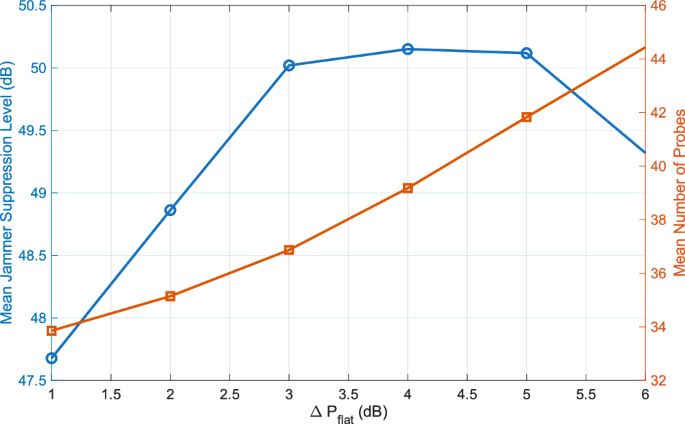
M-code and Signal Authentication
M-code is the jam-resistant military GPS signal: higher received power, encrypted, and spread in a way that lets it survive interference where the open C/A signal fails. It is the military answer to contested PNT.
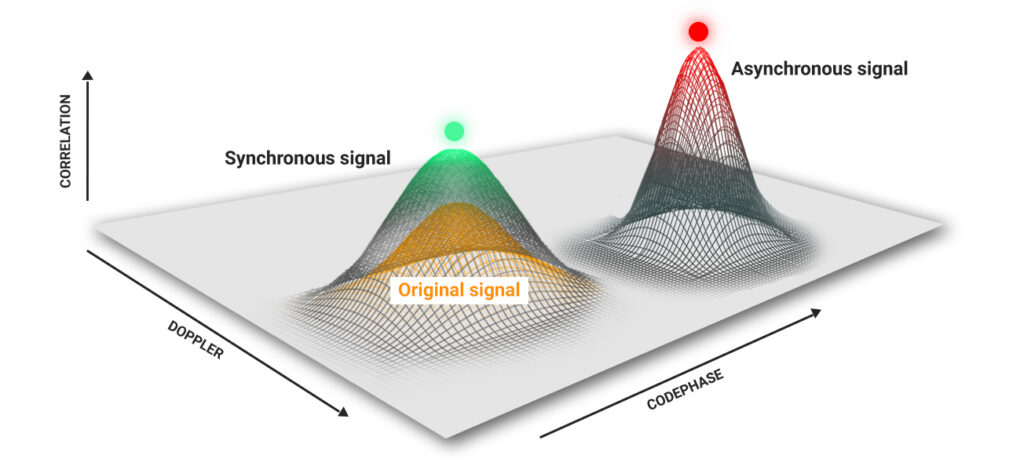
Civil users get the same idea through signal authentication: Galileo OSNMA and GPS Chimera/AS let a receiver cryptographically verify that a signal is genuine. Authentication is the spoofing counterpart to nulling—it defeats fake signals rather than loud ones. See our guide on anti-spoofing vs anti-jamming for why you usually need both.
GNSS Spoofing Detection — Beyond Nulling
Nulling stops jamming, but a spoofer sends valid-looking signals, so it needs a different check. GNSS spoofing detection combines several methods:
- Cryptographic authentication (M-code / OSNMA).
- Multi-constellation cross-validation (GPS + Galileo + BeiDou disagreeing reveals a fake).
- Consistency checks against inertial (INS) and odometry sensors.
- Clock and ephemeris anomaly detection.
The workflow is detect then reject: flag the suspect signal, then fall back to verified sources. For background on the threat itself, see GNSS jamming vs spoofing.
From Battlefield to Everyday — The Mapping
The technologies proven in Contested Environment PNT are not locked to the military. The same physics protects commercial and everyday users; only the packaging changes:
| Battlefield need | Commercial / everyday application |
|---|---|
| CRPA nulling on vehicles | Compact anti-jam modules for drones / UAVs |
| M-code jam resistance | Civil signal authentication (OSNMA, Chimera) |
| INS fusion under denial | Automotive ADAS and robotics positioning |
| Assured PNT for bases | Timing protection for power grids and telecom |
So when you read about military GNSS anti-jamming, read it as a preview of what resilient commercial navigation looks like—and increasingly must be.
How to Select Anti-Jamming for Your Platform
Selection is driven by threat level, size/weight/power (SWaP), and how long GNSS must survive. Practical guidance:
Anti-Jamming for Drones / UAVs
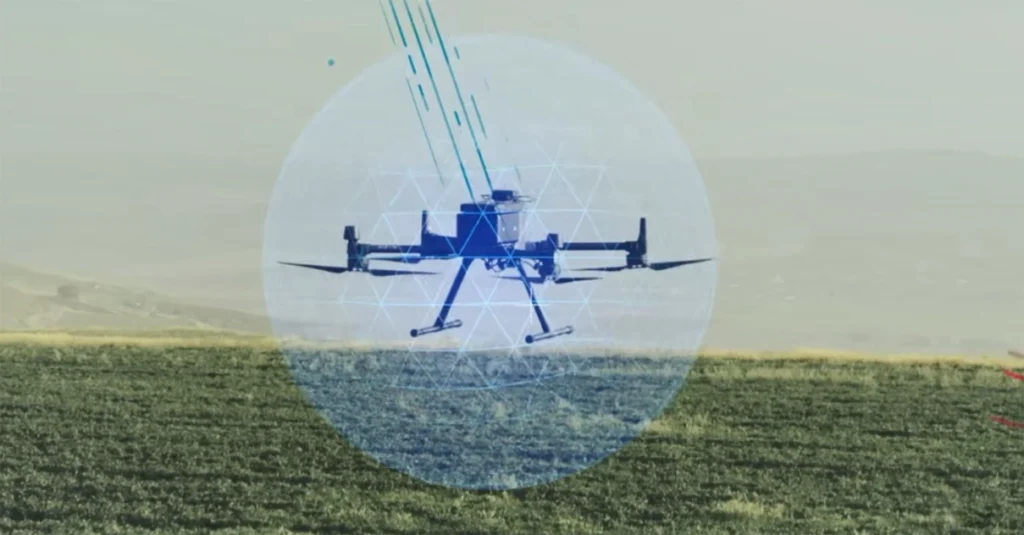
SWaP is tight, so a compact 4-element nulling module is the usual starting point—~20–30 dB J/S is enough for most commercial UAV operations, preserving control-link and geofence integrity. Prioritize low weight and low power draw, and pair with basic INS so the drone can bridge brief losses.
Anti-Jamming for Ships / Maritime
Size and power are less constrained, so a 7-element or larger array (≥35 dB J/S) gives robust protection for e-navigation and fleet timing through sustained interference. Mounting height and a clear sky view matter more than weight here.
Anti-Jamming for Fixed Sites / Infrastructure
For grid and telecom timing, a 12-element or rack-mounted solution (≥50 dB J/S) defends against the strongest regional denial. The priority is uninterrupted PNT, often with redundant INS and holdover clocks.
Specs Procurement Teams Actually Compare
- J/S nulling depth (the headline number).
- Number of antenna elements (4 / 7 / 12+).
- Supported constellations: GPS L1/L2/L5, Galileo E5a/E5b, BeiDou B1C/B2a/B3I, GLONASS.
- SWaP and integration footprint.
- Assured-PNT integration (INS / holdover).
- Authentication support (M-code equivalent / OSNMA).
For the underlying principles, read GNSS anti-jamming technologies explained and what a CRPA antenna is.
Procurement, Availability & Compliance
High-performance anti-jamming hardware is controlled. Availability depends on destination and end-use review. Defense and government operators should engage early—see our export compliance guidance and contact our team for program support. Many compact modules are available for commercial use today.
FAQ
Q: What is CRPA’s role in nulling?
A: A CRPA uses multiple antenna elements to place spatial nulls on jammers while keeping gain on satellites—the most effective way to reject interference before it reaches the receiver.
Q: What is M-code in military GPS, and does it help civilians?
A: M-code is a jam-resistant, encrypted military signal. Civilians get the same protection concept through signal authentication such as Galileo OSNMA and GPS Chimera.
Q: How does GNSS spoofing detection work?
A: By verifying signal authenticity (authentication), cross-checking constellations, and comparing against inertial/odometry sensors to reject fake positions.
Q: What J/S ratio do I need for a drone vs a ship?
A: A drone typically needs ~20–30 dB (compact 4-element); a ship benefits from ≥35 dB (8-element); fixed infrastructure often needs ≥50 dB.
Q: Is military anti-jamming technology available for commercial use?
A: Many compact anti-jam modules are commercially available; the highest-performance arrays are export-controlled—see export compliance.