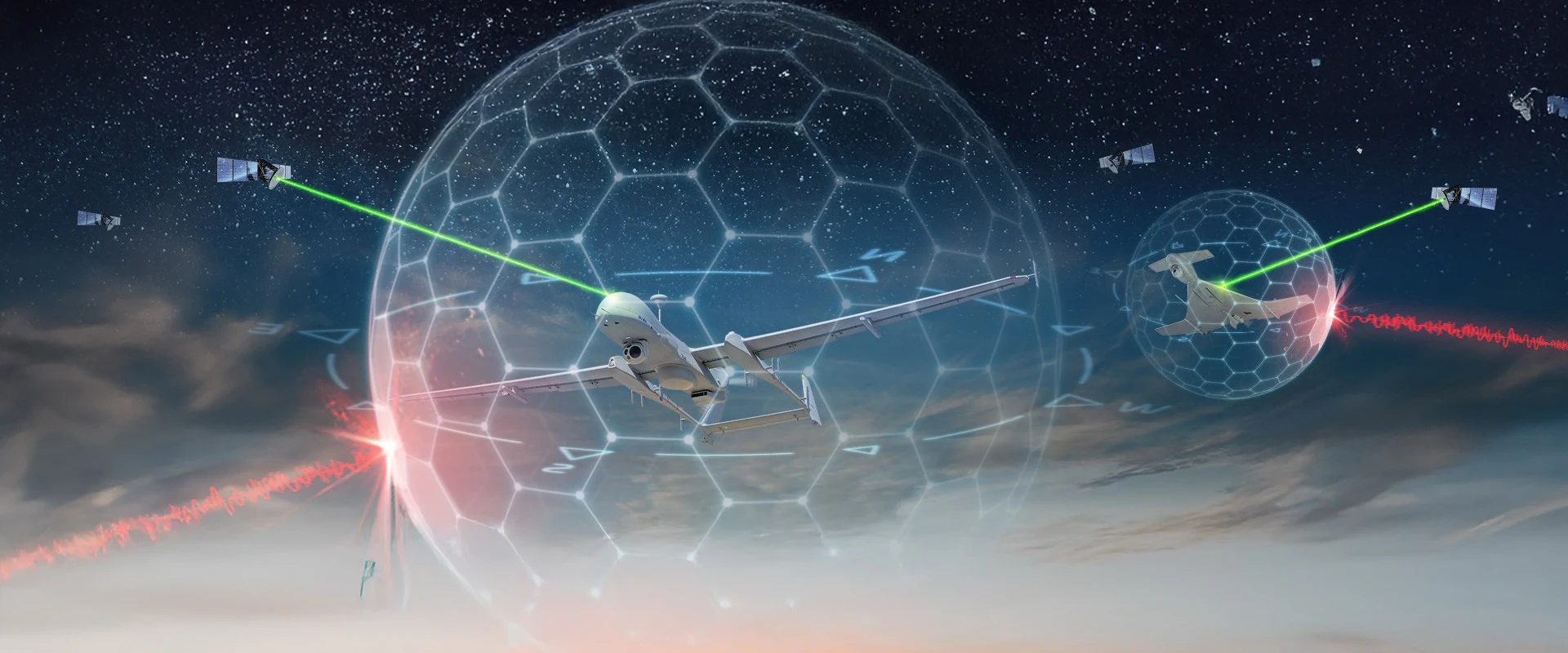
Civilian UAVs lean on GNSS for navigation, altitude hold, and return-to-home. In crowded or contested low-altitude airspace, jamming and spoofing are not theoretical risks: a jammed drone drifts and can lose its home point, a spoofed one can be pulled off its route without the operator noticing. That is what makes low-altitude security an engineering problem rather than a what-if.
Why civilian drones are easy targets
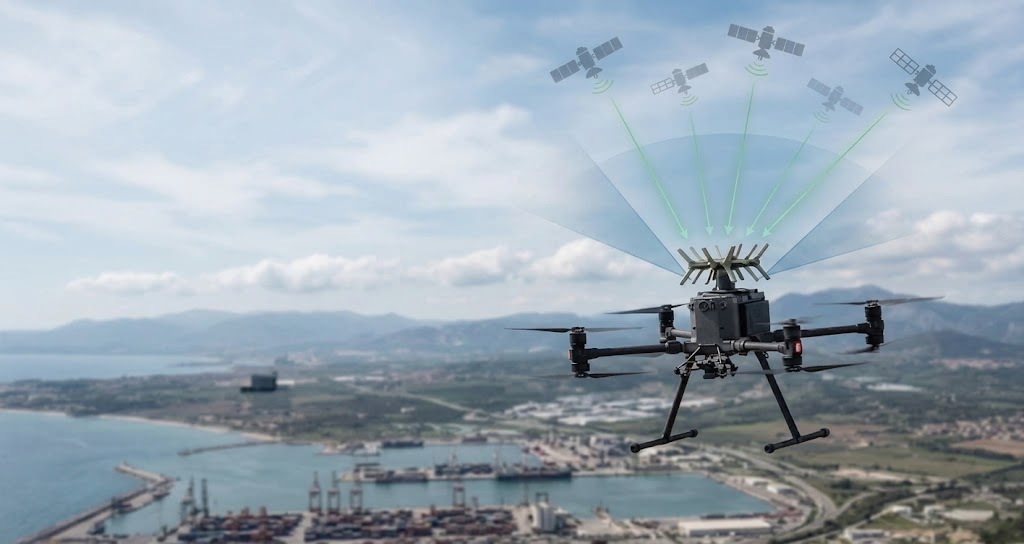
Size and cost decide the attack surface. A small airframe has to carry a light, low-power receiver and a compact patch antenna, and both sit at the weak end of what a jammer can reach:
- Low antenna gain. A typical micro patch antenna delivers roughly -2 to +3 dBi. A military CRPA array gets 10 dBi or more before any nulling is applied. Lower gain means less usable signal and a larger radius in which a jammer can break lock.
- No RF hardening. Civilian flight controllers are built to a price, not to a threat model. Most have no front-end filtering, no anti-jam processing, and no signal authentication.
- Thin redundancy. Lightweight craft usually skip a backup INS. When GNSS disappears, the attitude and position estimate degrades within seconds, and the drone starts to wander instead of holding station.
- Low attack cost. A handheld jammer with a few watts can knock out a receiver’s lock across several hundred meters. Drone signal margins are simply too tight to survive it.
The practical takeaway: a civilian drone is not meaningfully harder to disrupt than a smartphone, and its operator usually gets less warning.
What jamming and spoofing actually do to a drone
Jamming and spoofing fail a drone in different ways, and the response differs:
| Threat | What the drone experiences | Typical failure mode |
|---|---|---|
| Jamming (noise) | Position and velocity estimates freeze, then degrade | Drift, loss of return-to-home, uncontrolled landing |
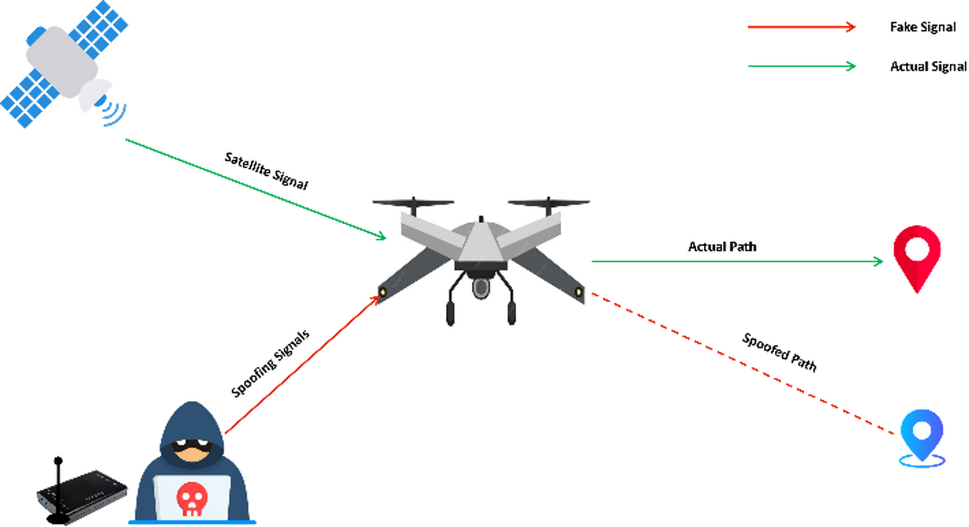
| Spoofing (fake signals) | A confident but wrong fix, often slowly dragged off-route | Hijacked flight path, geofence bypass, theft of the aircraft |
| Meaconing | Delayed genuine signals create phantom positions | Sudden jumps in the track used by the autopilot |
Spoofing is the more dangerous case for low-altitude security because the drone appears healthy right up until the point it is somewhere it should not be.
Protection stack for civilian drones
Robustness is layered, not a single box. Each layer answers one specific failure:
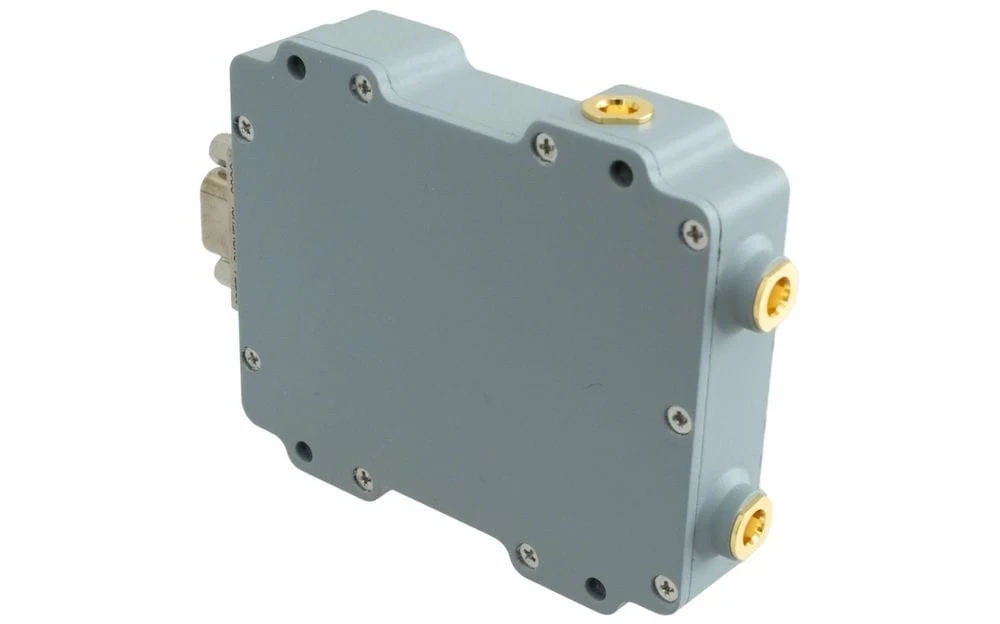
- Lightweight CRPA — the ~280 g 2-element GN-JS02-S1 steers one null at the jammer. It does not add much weight and it does not break a small airframe’s payload budget, but it only helps against noise jamming, not spoofing.
- Spoofing identifier — a small monitor that cross-checks signal geometry and authentication before the flight controller trusts the fix. It raises an alarm instead of letting a false position into the autopilot.
- Sensor fusion / INS — keeps attitude and position credible during short outages, bridging the seconds a jammer needs to force a lock loss.
- Fail-safe logic — on confirmed loss of GNSS, the flight plan falls back to a regulated hold / descend / return-to-home sequence rather than free drift.
Which layers matter depends on the aircraft and the mission:
| Platform | Typical payload budget | Minimum viable protection |
|---|---|---|
| Sub-250 g micro | < 50 g | Fail-safe logic + spoofing-aware flight planning |
| 250 g – 2 kg multirotor | 100–500 g | Sensor fusion, spoofing identifier, fail-safe |
| 2–10 kg surveying / delivery | 0.5–2 kg | Add 2-element CRPA (GN-JS02-S1) on top |
| 10 kg+ industrial | 2 kg+ | 4-element CRPA, full authentication stack |
From military nulling to civilian modules
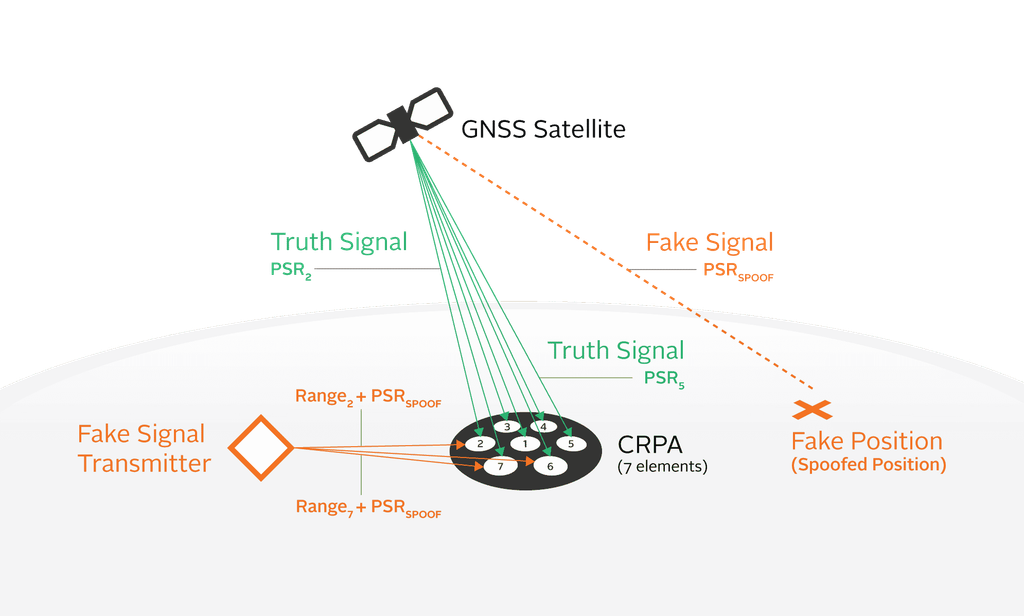
The nulling mathematics in military GNSS anti-jam systems transfer directly to civilian UAV resilience. The difference is packaging, not physics: military arrays use 7–12 elements and dozens of watts to null multiple simultaneous jammers, while a civilian module keeps the same adaptive beamforming principle in a single 2-element unit that draws a few watts and ships as a retail-ready part with civil certification.
| Parameter | Military CRPA system | Civilian module (GN-JS02-S1) |
|---|---|---|
| Elements | 7–12 | 2 |
| Simultaneous nulls | 5–10+ | 1 |
| Weight | Several kg | ~280 g |
| Power draw | 50–200 W | A few watts |
| Certification | Military standards | Civil (CE / FCC), UAV-suitable |
| Delivery | Integration program | Retail module for the same nulling result |
For surveying and mapping drones, this matters beyond security. A GNSS drop or a spoofed fix corrupts survey-grade positioning directly, so the same CRPA that defends against jamming also protects the accuracy of the map products. Military-grade hardening in that sense becomes a data-integrity tool for civilian survey work.
Operating discipline
Hardware buys margin; discipline keeps it. Before every flight in a contested area:
- Run a pre-flight interference check and review interference maps of the operating area.
- Confirm the mission’s fallback plan — where the drone goes if GNSS drops mid-route.
- Match the protection layer to the airframe payload budget, not to the brochure.
Resilience is a combination of antenna, detection, fusion, and procedure. A full anti-jamming overview maps each technique to the platforms that benefit from it.