
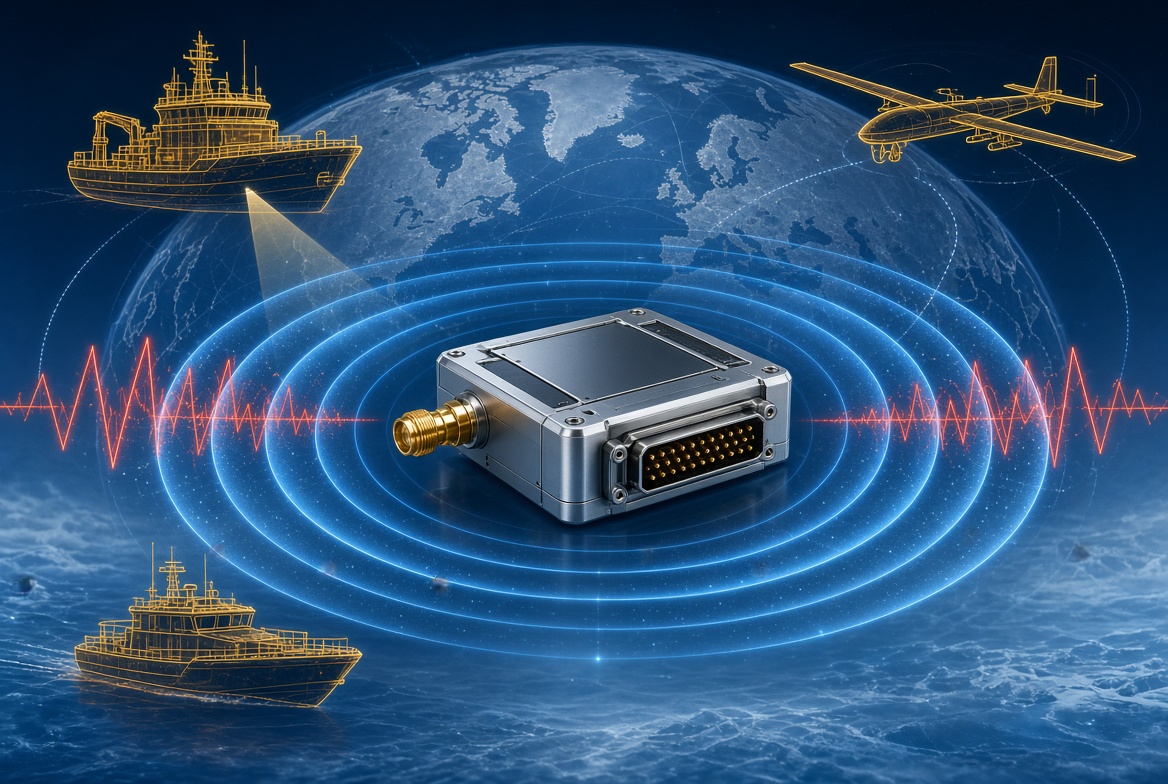
Anti-jamming refers to the techniques that let a GNSS receiver keep a valid fix while a jammer transmits noise on the same bands. For civilian UAVs, infrastructure, and autonomous platforms, it is the core of signal resilience.
Why jamming works
Civil GNSS arrives near −130 dBm. A low-power jammer nearby can raise the noise floor above the signal, causing loss of fix. The goal of anti-jamming is to improve the jammer-to-signal (J/S) margin.
Core techniques
- Adaptive nulling / CRPA: an array steers deep nulls toward the jammer while keeping the satellite direction clear. More elements = more simultaneous nulls.
- Null-steering algorithms: SMI, LMS and constrained optimum combine to place nulls with minimal signal loss.
- Front-end filtering: notch and SAW filters reject out-of-band interference.
- Polarization & processing gain: exploiting signal structure to lift the wanted signal above noise.
| Array (elements) | Concurrent nulls | Typical J/S gain |
|---|---|---|
| 2-element (GN-JS02-S1) | 1 | ~20–30 dB |
| 4-element (GN-JS04-S1) | Up to 3 | ~35–45 dB |
| 8-element (GN-JS08-S1) | Up to 7 | >50 dB |

How it fits together
Adaptive nulling requires a multi-element CRPA antenna; single antennas rely on filtering alone. Our how anti-jamming works article details the signal chain, and the technologies overview maps each method to a use case.
In practical systems, the above technologies are not isolated; they follow a “layered defense” logic:
- First Line of Defense (Front-End Physical Layer): At the hardware level, multi-element CRPA arrays (e.g., 4- or 8-element) and front-end SAW/notch filters physically attenuate incoming interference power at the RF front end, preventing front-end amplifier saturation.
- Second Line of Defense (Signal Processing Layer): After the digital baseband receives the signal, adaptive null-steering algorithms (such as SMI and LMS) calculate the direction of the interference sources in real time and dynamically adjust the array’s weighting phase to form deep nulls in the jammer’s direction, while maintaining high gain toward satellite signals.
- Third Line of Defense (Protocol and Measurement Layer): Even if residual interference remains, the receiver’s internal processing gain and polarization capabilities further “purify” the desired signal. Finally, combined with the receiver’s internal inertial measurement unit (IMU) data for integrated navigation, position outputs can be maintained even during very short periods of signal loss.
Therefore, actual anti-jamming performance depends on the synergy of these three layers:
- Countering single-direction interference: A 2- or 4-element CRPA is usually sufficient (providing 20–45 dB of gain).
- Countering multi-directional, high-intensity interference: An 8-element or higher CRPA array (providing >50 dB of gain) must be used, paired with advanced digital filters, to ensure no loss of satellite lock in complex electronic warfare or strong electromagnetic interference environments.
- Selection Recommendations: In space-constrained applications such as civilian drones and V2X (vehicle-to-everything), prioritize lightweight 4-element solutions. For fixed infrastructure, military, or high-risk operational scenarios, 8-element high-gain arrays must be deployed.
Summary: Anti-jamming is not a single chip or single algorithm; it is a deeply integrated closed-loop system of “multi-element antennas + adaptive weighting algorithms + filtering/processing gain.” The optimal configuration depends on a comprehensive assessment of expected interference intensity, the number of simultaneous interference sources, and the physical size constraints of the terminal equipment.
Beyond jamming
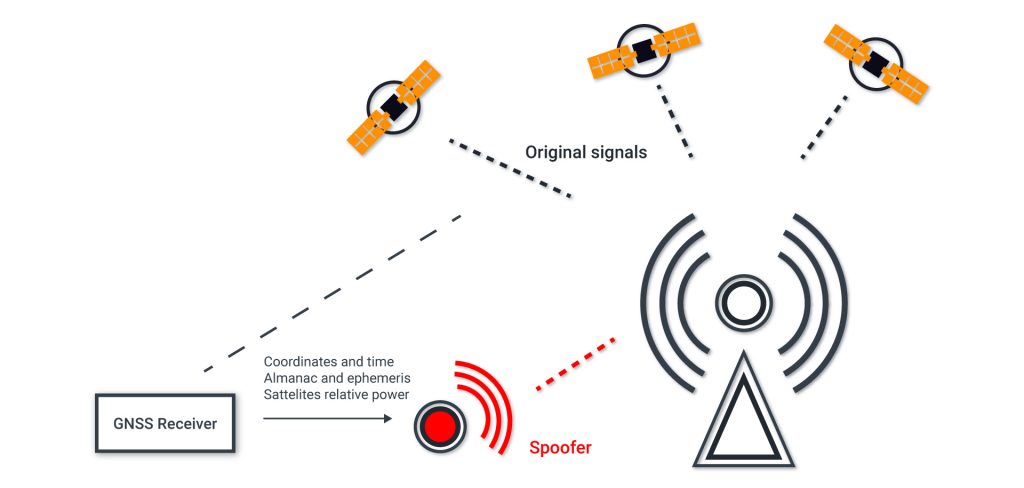
Nulling defeats noise jammers but not fake-signal spoofing; pair it with authentication (M-code / OSNMA) and a spoofing detector.
See specs: NavShield CRPA series.