
By Dr. Helena Voss, Principal RF Engineer at NavShield Global (15 years in PNT protection and adaptive-antenna design). Technical review by the NavShield RF team.
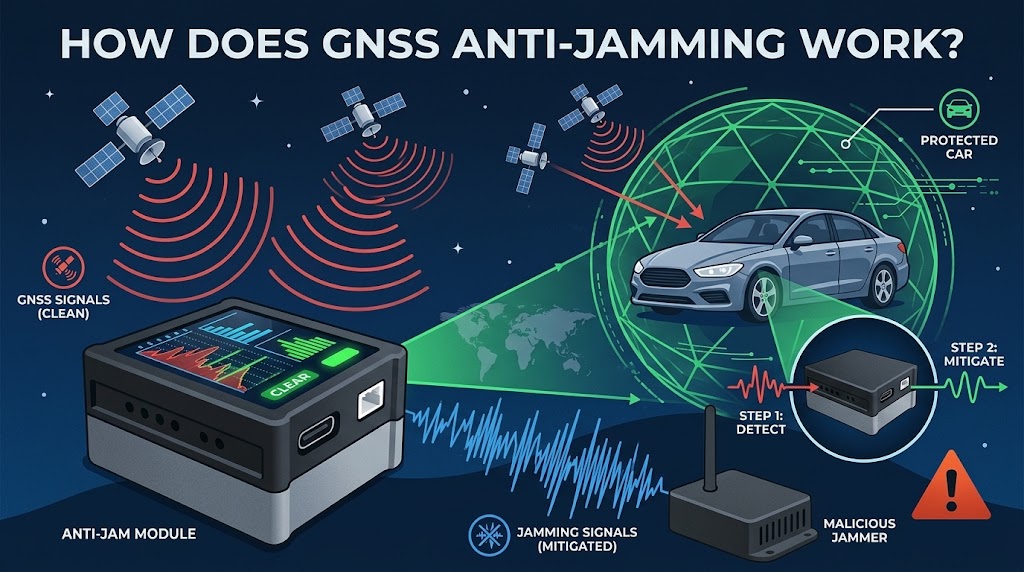
GNSS signals arrive at the antenna at around -130 dBm — weaker than the ambient noise floor and well below thermal noise. This extreme vulnerability means that even low-power interference can easily jam reception, which is precisely why countermeasures must begin at the antenna element itself. This article breaks down the core anti-jamming techniques that keep navigation alive under interference, and explores how NavShield Global integrates these protections into ruggedized hardware.
Why GNSS Is Easy to Jam
A GPS signal at the antenna is roughly -130 dBm. A modest handheld jammer a few kilometers away can lift the local noise floor by 40–60 dB and overwhelm the receiver. Software alone cannot recover a signal buried that deep — the fix has to happen in the RF front end, before the signal is ever digitized. The same GNSS anti-jamming problem appears on every platform that depends on satellite navigation.
The Three Major Hardware-Level Anti-Interference Technologies for GNSS
Technique 1 — Adaptive Nulling (CRPA)
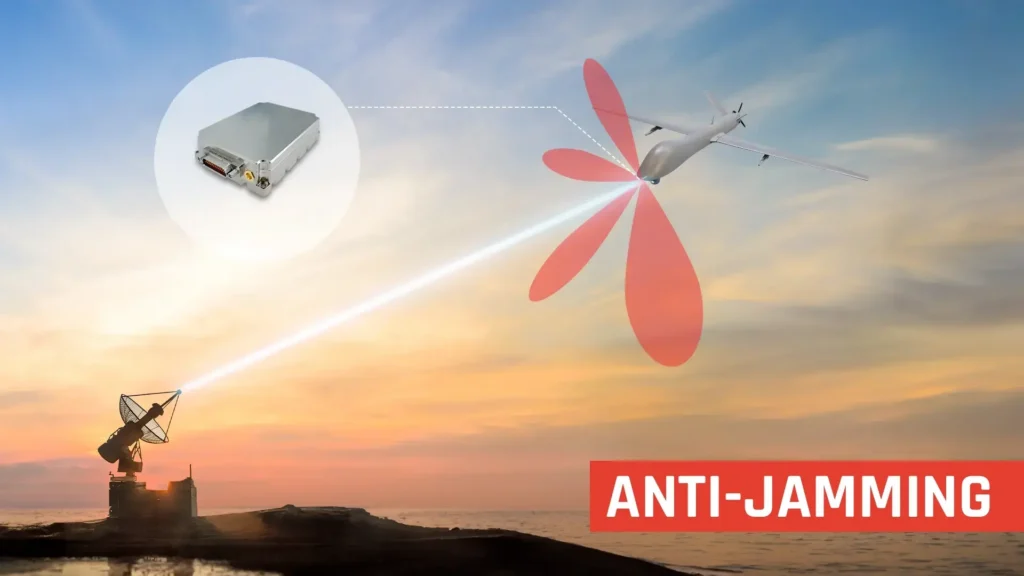
The primary GNSS anti-jamming method is adaptive array processing. A CRPA antenna uses multiple elements and a beamformer that estimates the interference bearing and drops a null on it. For example, if a jammer sits 30 degrees above the horizon, the beamformer simply places a null at that angle while satellites elsewhere remain fully received. Each null suppresses one strong jammer; an 8-element array can null several at once. The processing detail lives on our adaptive nulling technology page.
Technique 2 — Filtering and Processing Gain
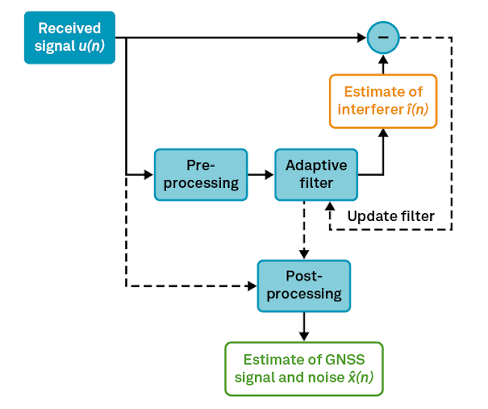
A second defensive layer uses narrowband surface-acoustic-wave filters and spread-spectrum processing gain to reject out-of-band and non-correlated energy. Image-reject and band-pass filters also remove emitters such as cell towers and radar that would otherwise desensitize the front end. Combined with nulling, they raise the effective jamming-to-signal margin by tens of decibels, buying the receiver the headroom it needs to keep tracking.
Technique 3 — Multi-Constellation Diversity
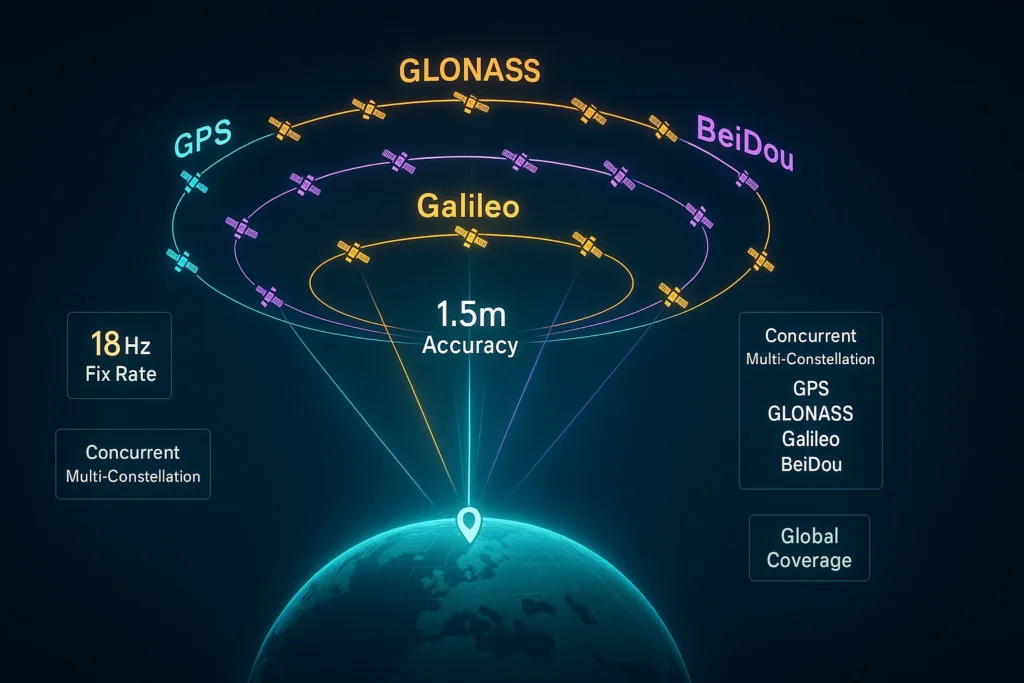
A third protective pillar uses GPS + GLONASS + Galileo to spread energy across more bands and satellites, so a jammer must cover a wider spectrum to be effective. That broader footprint also raises the attacker’s cost, because blanketing every tracked band demands far more power than hitting one. The band layout that makes this work is in our GNSS frequency bands guide.
| Technique | What it adds | Jamming limit |
|---|---|---|
| Adaptive nulling | Spatial rejection of jammers | Handles several strong jammers |
| Filtering and processing gain | Rejects out-of-band energy | Weakens broadband noise |
| Multi-constellation diversity | More bands and satellites | Forces wider jammer coverage |
| Anti-spoofing cross-checks | Excludes fake signals | Stops falsified positions |
Technique 4 — Anti-Spoofing Cross-Checks
The final GNSS anti-jamming defense targets spoofing rather than noise. Jamming blanks the signal; spoofing replaces it with a fake. Defense needs authentication markers, arrival-angle consistency, and power-anomaly detection — arrival-angle consistency, for instance, compares the direction each signal claims to come from against the geometry the array actually measures, and a spoofed signal that disagrees is flagged and dropped. NavShield’s GNSS anti-spoofing detector flags and excludes spoofed signals before they corrupt the navigation solution.
How the Techniques Combine in a Receiver Chain
These GNSS anti-jamming methods are not mutually exclusive. In a real front end, pre-filters strip obvious out-of-band energy, the CRPA array nulls the strongest in-band jammers, diversity keeps alternate signals available, and spoofing checks validate the surviving fix. Among these approaches, nulling does the heaviest lifting, but the stack is what delivers continuous PNT.
Deployment Considerations
Sizing this hardware is a trade-off. Nulling costs size, power, and money that scale with element count: a 2-element build suits power-limited UAVs, while an 8-element array suits fixed stations with abundant power. Because nulling happens at the RF front end, it is largely transparent to the downstream receiver — the same satellite data flows through, just cleaner — which lets a CRPA drop into an existing navigation stack without rewriting the software. The right choice depends on the jamming environment and the cost of losing the fix, not on a generic “more is better.”
Bottom Line
The four GNSS anti-jamming techniques — adaptive nulling, filtering, multi-constellation diversity, and anti-spoofing cross-checks — work as a stack. Start with a CRPA antenna module built for your platform, then add spoofing detection for full coverage. For the underlying threat model, see how GNSS anti-jamming works in practice.