
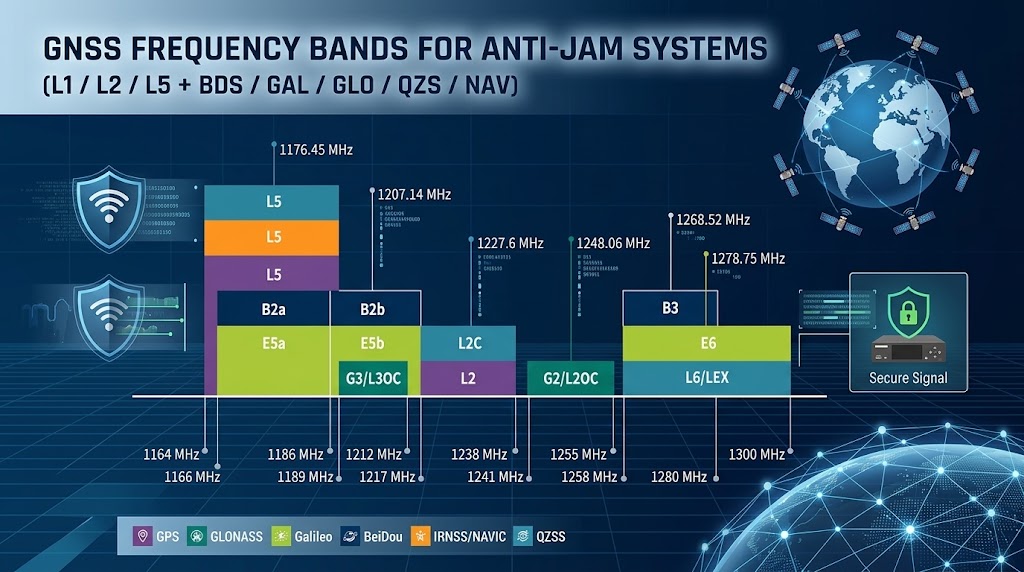
Frequency choice is a critical factor that determines both positioning accuracy and anti-jam resilience. This guide breaks down the major GNSS frequency bands (GPS L1/L2/L5, BeiDou B1/B2/B3, Galileo E1/E5/E6, GLONASS G1/G2/G3) and explains why multi-band coverage is essential for robust interference protection. Whether you are deploying CRPA arrays for UAVs, autonomous vehicles, or critical infrastructure, understanding band-specific signal characteristics is the first step toward a reliable anti-jam strategy.
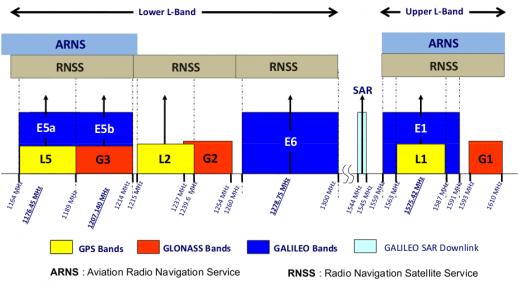
The core bands
| Constellation | Bands | Notes |
|---|---|---|
| GPS (US) | L1 / L2 / L5 | L5 higher power, better multipath |
| BeiDou (CN) | B1 / B2 / B3 | B1C/B2a modernized civil signals |
| Galileo (EU) | E1 / E5 / E6 | E5 wideband, robust |
| GLONASS (RU) | G1 / G2 / G3 | FDMA heritage |
Why L5/E5/B2 help under interference
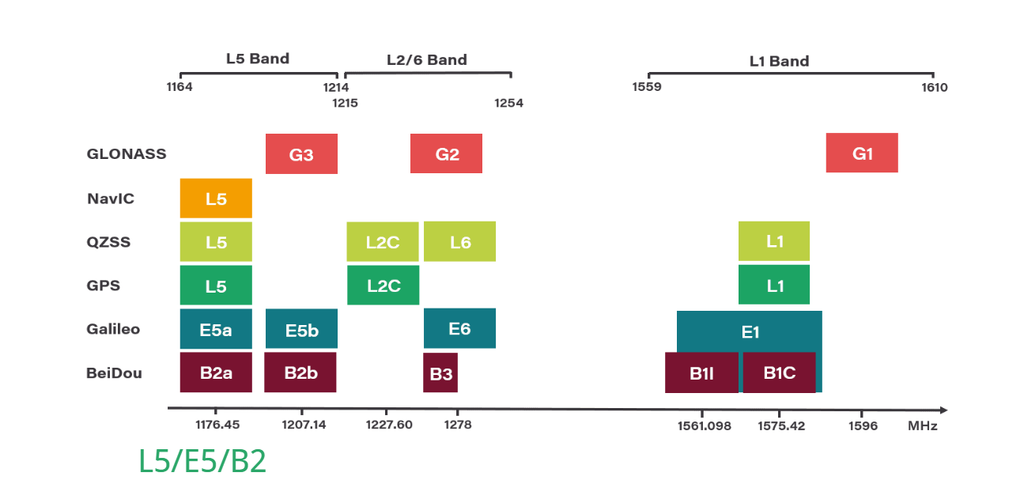
Why L5/E5/B2 Gain an Edge Under Interference
Modernized signals like GPS L5, Galileo E5, and BeiDou B2a are designed with higher transmit power and advanced spreading codes, which offer three distinct advantages in contested RF environments:
- Higher power margin: Compared to legacy L1 signals, L5/E5/B2a typically operate at higher power levels, which naturally improves the J/S (Jammer-to-Signal) margin. This means they can withstand a higher noise floor before losing lock.
- Better code structure: The improved modulation (e.g., BPSK(10) and AltBOC) provides superior correlation and multipath rejection, helping receivers maintain accurate tracking even when the signal is weakened.
- Graceful degradation: When a jammer raises the noise floor, multi-band receivers can fall back to the strongest available band. Systems covering L5/E5/B2 degrade more gracefully, maintaining a coarse fix or timing output instead of completely dropping out.
Anti-jam implication: A CRPA array must cover every band you intend to protect. Partial band coverage leaves a vulnerability—a jammer could simply target the unprotected legacy band. For robust anti-jam protection, always prioritize full-band CRPA solutions that cover L1/L2/L5, B1/B2/B3, and E1/E5/E6 simultaneously.
Anti-jam implication
A CRPA array must cover every band you intend to protect; partial coverage leaves a hole a jammer can exploit. Our full frequency bands explainer goes deeper, and the technology page lists protected bands per model.
Planning tip
Track all constellations in your outage plan so losing one band doesn’t mean losing the fix. See also GPS vs GLONASS vs Galileo.