
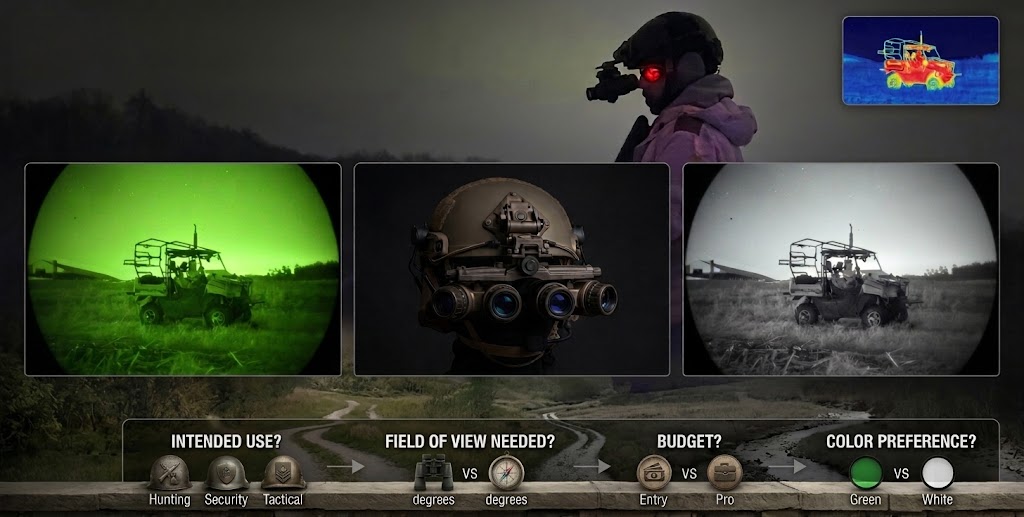
The term “night-vision goggles” encompasses everything from toys costing a few hundred yuan to professional-grade equipment priced at tens of thousands of dollars. The vast price disparity stems fundamentally from the immense differences in core technology, which directly determine their performance, suitable applications, and ultimate value.
For a deeper look at full-color digital systems, see our Complete Guide to Full-Color Night Vision. If you are searching for a lightweight, purpose-built solution, the NT-C11 digital viewer delivers full-color performance without the bulk.
Three Core Technologies
- Image intensifier tubes (I2): The classic green night vision. Excellent sensitivity, but monochrome and prone to blooming in bright light.
- Digital night vision: Uses a CMOS sensor and display. Can be full-color, records video in some models, and is more tolerant of bright light.
- Thermal fusion: Combines I2 or digital with thermal overlay. Best of both worlds, but heavy and expensive.
Night Vision Goggles – Types, Specifications, and How to Choose
The term “night vision goggles” covers everything from a $300 toy to a $40,000 military‑grade system. The price gap isn’t random – it reflects fundamental differences in technology, performance, and intended use.
At a Glance: Entry‑Level vs. Professional Systems
| Aspect | Entry‑Level / Toy‑Grade | Professional / High‑End Systems |
|---|---|---|
| Core Technology | Mostly digital night vision or Gen 1 image intensifier tubes | Gen 2 / Gen 3 tubes or high‑end thermal imaging |
| Key Component | Standard CMOS sensor – inexpensive to produce | Image intensifier tube – the most expensive and critical “engine” of the device |
| Price Range | ~$200 – $800 | ~$3,500 – $40,000+ |
| Performance | Relies heavily on ambient light; effective range <100 m; image edges are often blurry | Extremely high sensitivity; delivers crisp images under starlight; recognition range of several hundred metres |
| Primary Use | Backyard observation, Airsoft, and recreational activities | Military, law enforcement, professional search & rescue, and other serious applications |
Why the Huge Price Difference? It All Comes Down to “Generation”
The single most important factor determining cost is the generation of the image intensifier technology.
Gen 1 – The Entry Point
- Basic night vision technology.
- Limited performance – image edges are soft, and the device struggles in low‑light conditions without an IR illuminator.
- This is the standard technology found in most entry‑level and toy‑grade products.
Gen 2 – The Big Leap
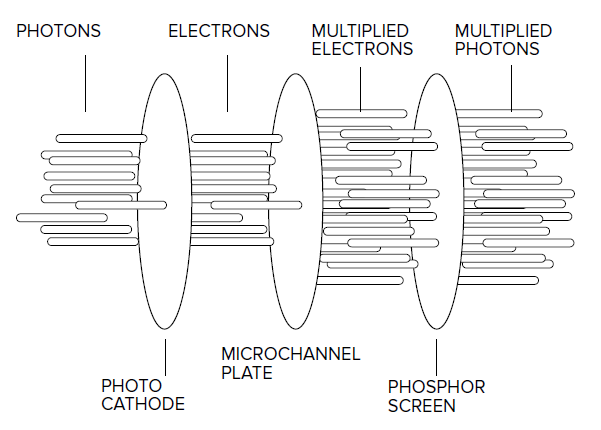
- Introduces the Microchannel Plate (MCP), which delivers a massive boost in performance.
- Sensitivity and clarity improve dramatically; effective range reaches 200–400 metres.
- Priced at ~$1,500 – $3,500, this is the go‑to choice for serious hobbyists and security applications.
Gen 3 – Military‑Grade Performance
- Uses advanced gallium arsenide photocathodes for peak sensitivity.
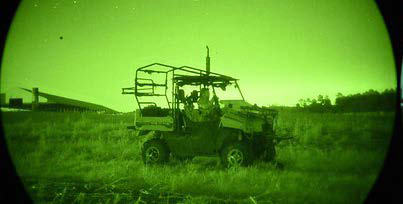
- Delivers clear imaging in near‑total darkness.
- This is true “military‑grade” technology:
- A monocular device (like the PVS‑14) costs ~$2,500 – $4,500.
- A binocular (dual‑tube) system runs ~$7,000 – $13,000+.
Panoramic Goggles – The Ultimate System
- This is where prices reach $40,000 or more.
- Systems like the US military’s GPNVG‑18 use four image intensifier tubes to deliver an ultra‑wide field of view of nearly 120°.
- In essence, they combine multiple top‑tier Gen 3 components into a single device – so the cost and complexity multiply accordingly.
Beyond the Tube – Additional Cost Drivers
High‑end night vision systems don’t just have better tubes. They also feature:
- Superior housing materials – rugged, lightweight alloys or composites.
- Premium optics – high‑quality glass lenses with anti‑reflective coatings.
- Advanced sealing – proper waterproofing and fog‑proofing for harsh environments.
All of these add to the manufacturing cost – and to the final price tag.
How to Choose
- Define your primary task: detection, identification, or navigation.
- Set a weight and power budget.
- Decide whether color information matters for your application.
- Confirm local ownership and export rules.
- Test in your actual environment before a bulk purchase.
FAQ
What are the different types of night vision goggles?
They fall into image intensifier (green), digital (often color), and thermal-fusion systems, each with different strengths and price points.
How much do good night vision goggles cost?
Quality digital systems start around $1,000; high-end image intensifier or fusion systems can exceed $10,000.
Are digital night vision goggles any good?
Modern digital systems offer color, no blooming, and lower cost. They are excellent for identification and observation in most ambient-light conditions.
Specs only mean something once they are matched to the job. A full-color digital unit like the NT-C11 is a good reference point; our team can recommend against your use case rather than against a price band.