
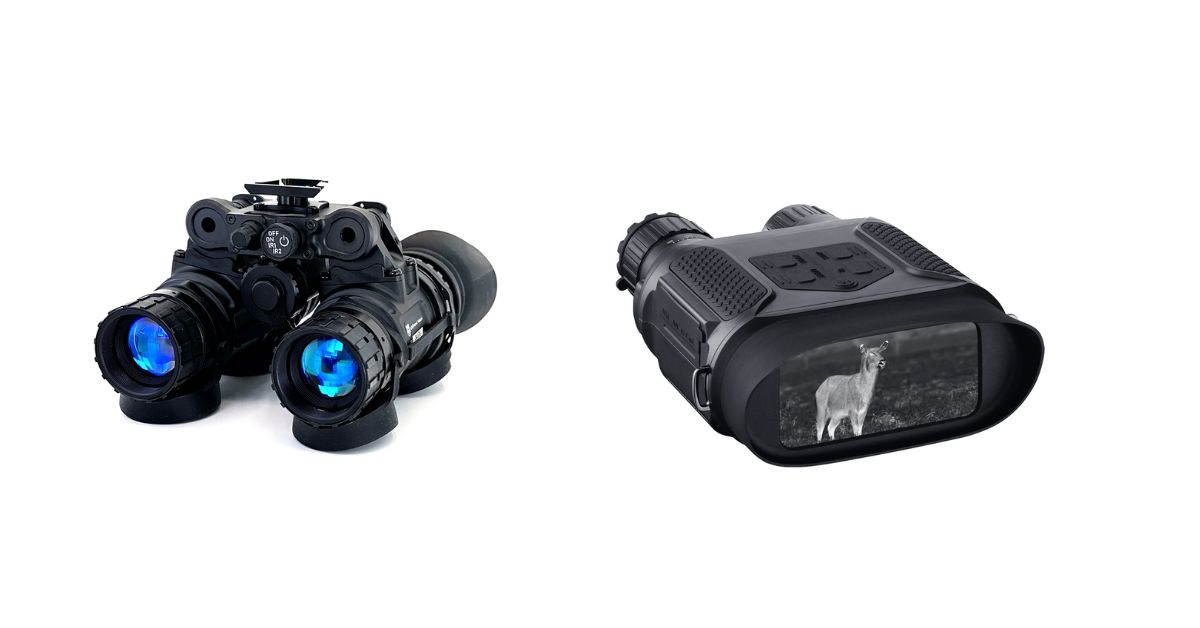
Buyers often confuse night vision binoculars with night vision goggles. The difference is not just shape; it is how you use them. One is optimized for handheld observation, the other for hands-free movement. Choosing the wrong form factor wastes budget and limits capability.
This article compares the two formats, explains when each wins, and shows how a compact monocular viewer like the NT-C11 can serve both roles with the right accessories.
Night Vision Binoculars vs. Goggles – A Quick Comparison
Both let you see in the dark. But they serve completely different missions. Here’s what you actually need to know.
Binoculars – For Stationary Observation
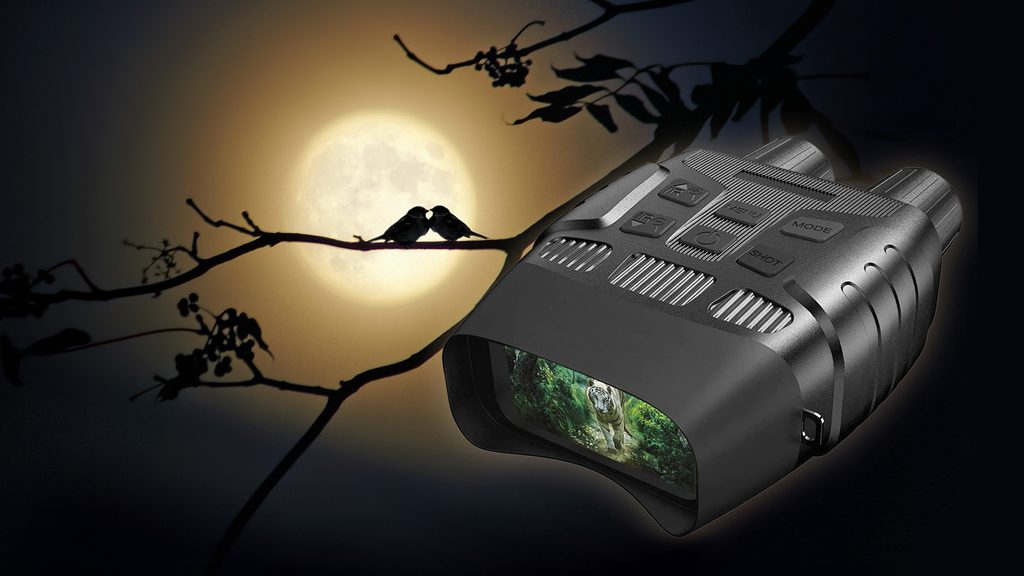
What they are: Two optical channels in a handheld or tripod‑mounted body. Like your daytime binoculars, but night‑vision capable.
Best for:
- Wildlife watching from a blind or vehicle
- Fixed security posts (perimeter gates, checkpoints)
- Marine navigation (helmsman scanning channels)
- Surveillance where you don’t need to move
Advantages:
- True depth perception – two eyes, two paths
- Comfortable for long sessions – especially on a tripod
- Higher magnification available (7× – 12×) for distant detail
- Familiar operation – pick up and use instantly
Trade‑offs:
- Heavy – 800 g – 1,500 g. After 15 minutes handheld, arm tremor sets in.
- Tripod‑dependent for extended use – adds another piece of gear
- Bulky – awkward to walk with; neck strap swing is a nuisance
- Narrow field of view – 5° – 15° creates tunnel vision
- Expensive – two tubes = roughly twice the cost of a monocular with similar performance
Goggles – For Mobility and Hands‑Free Work
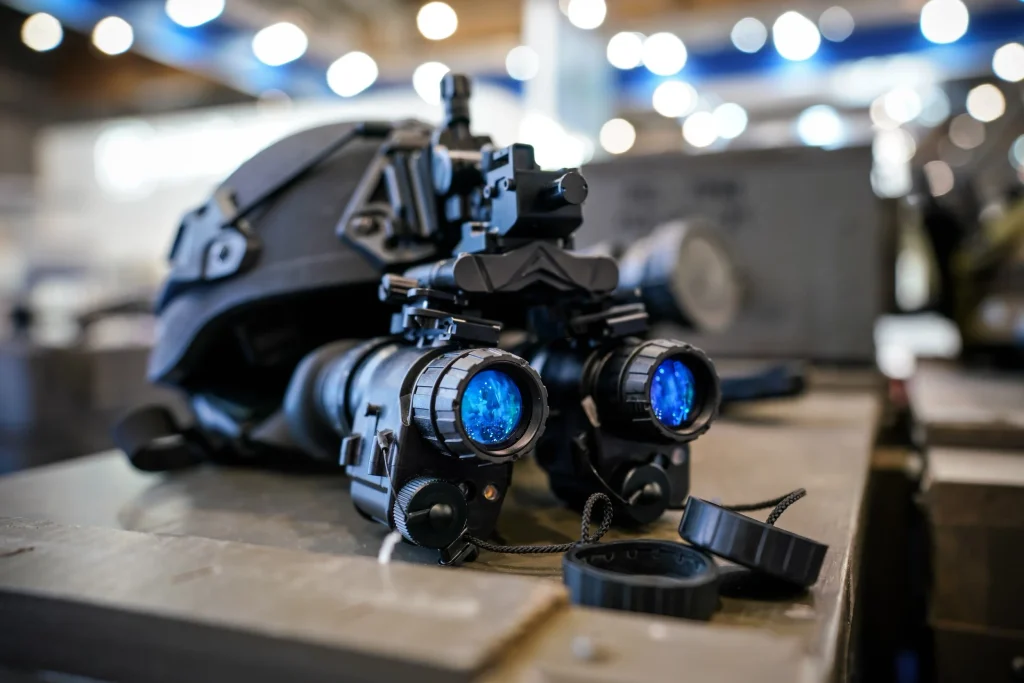
What they are: Dual‑tube, head‑mounted systems that free both hands while preserving depth perception.
Best for:
- Dismounted patrol and tactical movement
- Driving, flying, or navigating in darkness
- Any task where both hands are busy (weapons, maps, tools)
- Close‑quarter operations
Advantages:
- Hands‑free – both hands available for equipment
- True depth perception – essential for moving over uneven terrain
- Wide field of view – 40° – 50° typical; up to 120° on panoramic models
- 1× magnification – objects appear natural size; spatial awareness stays intact
- Head‑tracking – look where you want to see; no aiming required
Trade‑offs:
- Neck fatigue – 450 g – 900 g on your head, plus helmet (1.2 – 1.5 kg). After 2–3 hours, it’s noticeable.
- Cost – dual tubes mean dual price. Gen 3 systems start at ~$7,000 and go to $13,000+.
- Requires helmet and mount – not usable out of the box; adds cost and complexity
- Reduced peripheral awareness – still narrower than natural vision
- Shorter battery life – two tubes draw more current than a monocular
The Third Option – Monocular Viewer (The Sweet Spot)
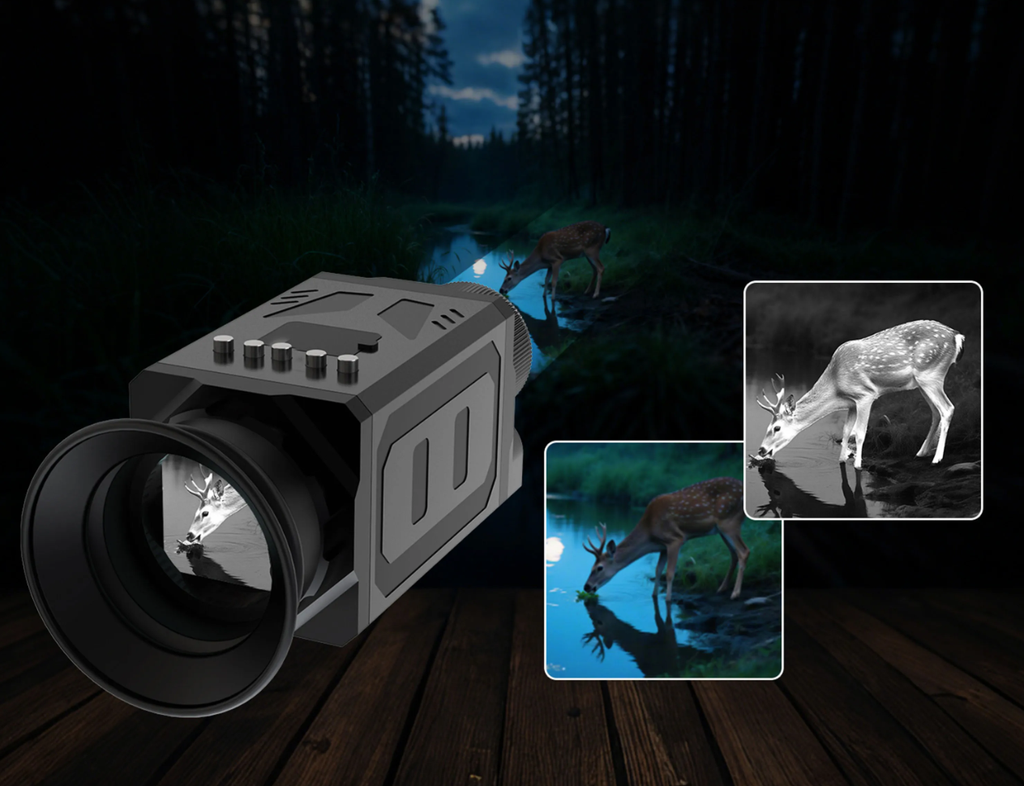
Between the heavy binocular and the expensive goggle lies the monocular viewer – one tube, one eyepiece, one simple device.
Key numbers:
- Weight – ≤285 g (NT‑C11). Less than half of binoculars or goggles.
- Cost – Under $1,300. Roughly half the price of a Gen 2 goggle system.
- Mounting – Handheld or helmet‑mounted (versatile).
- Battery – Single tube draws less; longer runtime per charge.
The trade‑off: You lose binocular depth perception. But for most observation, patrol, and SAR tasks, that’s an acceptable compromise for the weight and cost savings.
Monocular Viewers: The Hybrid Option
A monocular viewer like the NT-C11 sits between the two. Handheld, it functions like a compact binocular. Add a helmet mount and it becomes a single-tube goggle. At 285 g, it is far lighter than most dual-tube systems. The 42.5° diagonal FOV and 50 Hz refresh rate support both scanning and movement.
| Factor | Binoculars | Goggles | Monocular Viewer |
|---|---|---|---|
| Use | Stationary | Hands-free movement | Handheld + optional mount |
| Weight | Heavy | Moderate-heavy | Light (285 g) |
| Depth perception | Yes | Yes (dual-tube) | Limited |
| Cost | $$$ | $$$$ | $$ |
FAQ
For stationary observation, yes. For movement and hands-free tasks, goggles or a helmet-mounted monocular are better.
Yes, with a compatible helmet mount. The NT-C11 can be used handheld or mounted depending on accessories.
A lightweight monocular viewer is usually the most versatile and affordable starting point.
The right form factor comes down to how the device will be carried and what the operator needs to see. If a compact viewer fits the use case, the NT-C11 is a reasonable spec benchmark to start from.