
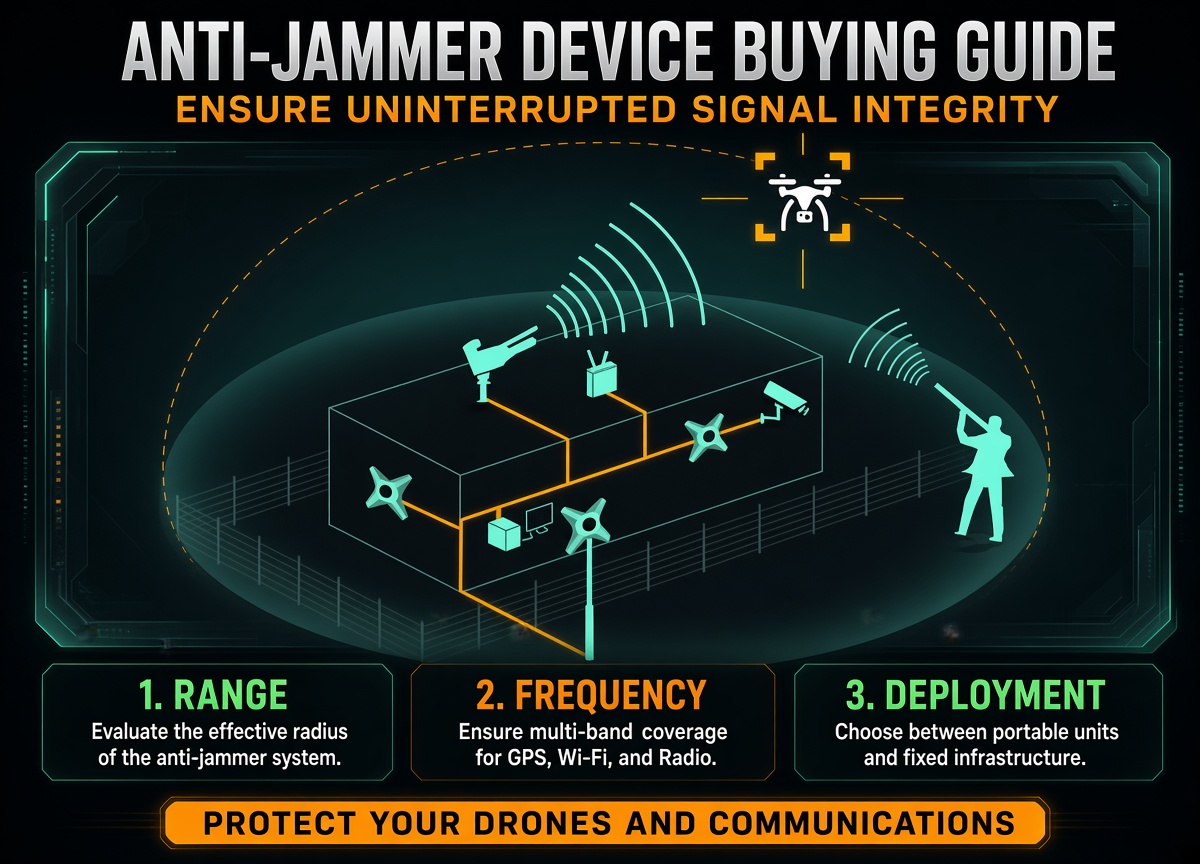
An anti-jammer device protects GNSS receivers from interference. This buying guide focuses on what actually matters when specifying protection for UAVs, vehicles, and fixed sites.
1. Architecture: single antenna vs CRPA
A single GPS/anti-jam antenna with filtering is cheap but offers limited nulling. A CRPA array steers nulls and is the real anti-jam solution for contested environments.
Architecture Comparison: Single Antenna vs. CRPA (Revised & Optimized)
| Comparison Dimension | Single Antenna + Filtering | CRPA Array (2/4/8 Elements) |
|---|---|---|
| Anti-Jamming Logic | Frequency-domain defense: Suppresses only out-of-band spurious signals or specific narrowband tones via front-end SAW/notch filters. Ineffective against in-band wideband interference. | Spatial-domain nulling/beamforming: Utilizes adaptive spatial algorithms to steer deep nulls toward interference sources, effectively canceling same-frequency, strong in-band jammers. |
| J/S (Jammer-to-Signal) Capability | In-band wideband: 0 dB (completely ineffective). Out-of-band / narrowband filtering: Typically ≤ 10–15 dB. | 2-element: ~20–30 dB 4-element: ~35–45 dB 8-element: ≥ 50–60 dB |
| Multi-Jammer Suppression | Cannot spatially distinguish or suppress multiple simultaneous in-band jammers. | Provides N–1 spatial degrees of freedom. (4 elements can null up to 3 directions; 8 elements up to 7 directions). |
| Signal Integrity & Distortion | Transition bands of analog filters may introduce group delay; strong in-band interference directly causes baseband saturation and loss of lock. | Maintains gain toward satellite directions, but deep adaptive nulling may introduce Group Delay Variation and Phase Center Variation (PCV). This can impact cm-level RTK/carrier-phase accuracy unless paired with dedicated calibration algorithms. |
| SWaP-C (Size, Weight, Power, Cost) | Extremely compact, low power, low cost (consumer / standard industrial grade). | Larger footprint; requires multi-channel synchronized RF front-ends and FPGA/DSP co-processors. Higher power consumption and cost (specialized / high-reliability industrial and defense grade). |
| Target Applications | Open-sky outdoor environments, consumer IoT, general commercial vehicle navigation. | UAV/USV counter-UAS defense, high-reliability V2X main controllers, power grid time synchronization, and specialized defense/military equipment. |
2. Nulling depth and concurrent nulls
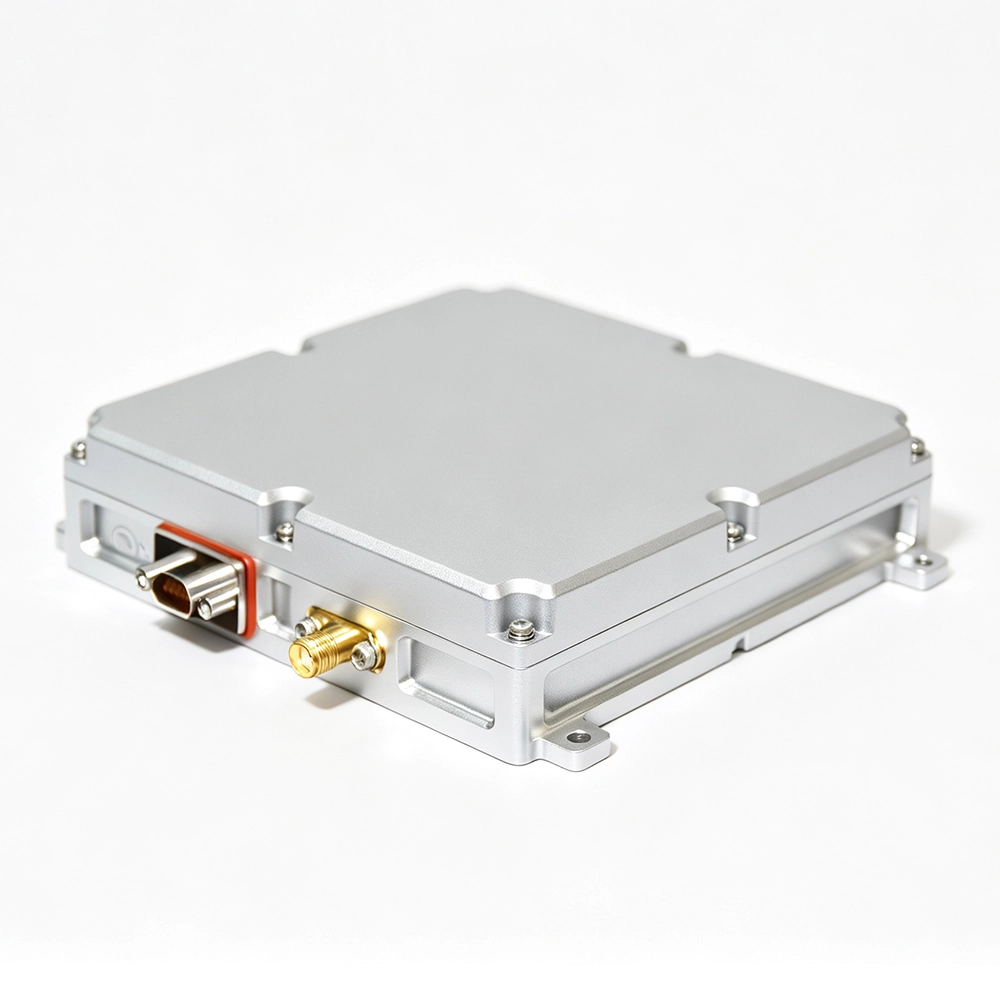
Look for J/S gain and how many jammers can be rejected at once. More array elements = more concurrent nulls.
| Model | Elements | Concurrent nulls | Suppression |
|---|---|---|---|
| GN-JS02-S1 | 2 | 1 | 30–40 dB |
| GN-JS04-S1 | 4 | Up to 3 | 40–50 dB |
| GN-JS08-S1 | 8 | Up to 7 | >50 dB |
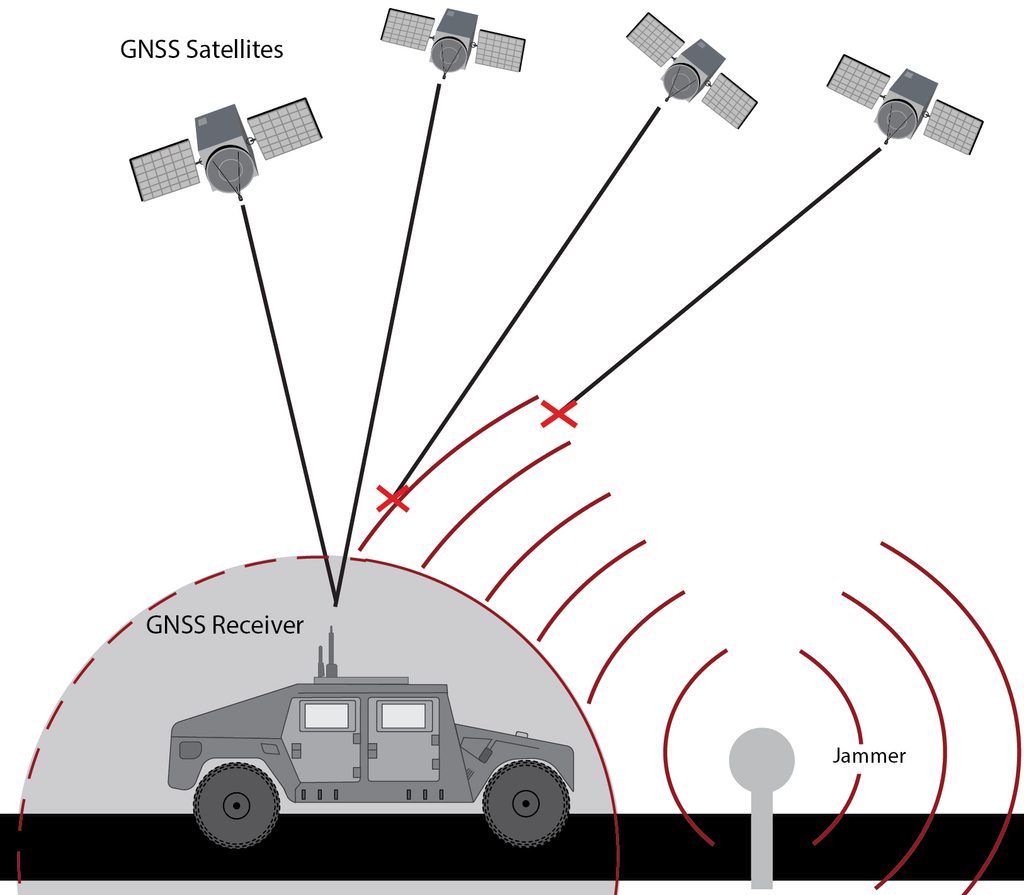
3. Bands and constellations
Ensure coverage of GPS L1/L2/L5, BeiDou B1/B2/B3, Galileo E1/E5 and GLONASS — see the bands guide.
4. Response time and weight
Detection under 100 ms and nulling under 20 ms keep the fix alive. For airborne use, weight matters: ~280 g (2-el) to ~1.5 kg (8-el). Confirm MIL-STD-810H / DO-160 certification.
5. Pair with spoofing defense
Nulling alone won’t stop spoofing. Add a spoofing detector and M-code/OSNMA support.
Compare all models on the products page, or request a quote.