
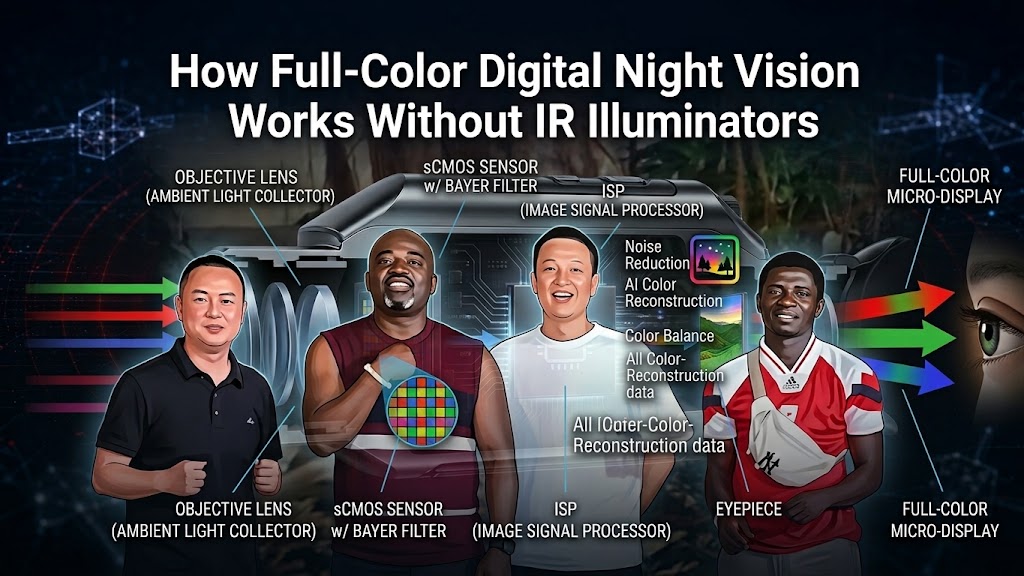
The answer lies in ultra-low-light CMOS sensors. Rather than actively emitting light, these devices function like highly sensitive cameras that capture faint ambient visible light—such as starlight, moonlight, or skylight. Using large-pixel, back-illuminated sensors and real-time digital image processing algorithms, they amplify the signal to a level visible to the human eye. The NT-C11 operates on this very principle, rendering color images that resemble daylight views even in near-total darkness.
However, the vast majority of consumer‑grade night vision devices take a different approach – they rely on infrared (IR) illuminators, which project a beam of invisible IR light forward and then capture the reflected signal to form an image. While straightforward and effective, this method comes with inherent drawbacks:
- Poor concealment – IR light is invisible to the naked eye, but anyone else using night vision equipment can easily spot the illuminated “glow,” effectively giving away your position.
- High environmental sensitivity – Rain, snow, fog, glass, or wet surfaces scatter IR light severely, reducing effective range and causing glare.
- Increased power consumption and bulk – The illuminator requires extra power and heat management, making the device heavier and shortening battery life.
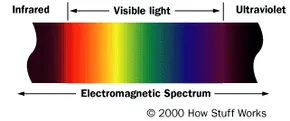
Why Avoid Infrared Illuminators?
For professional users – especially Search and Rescue (SAR) teams, security patrols, and field observers – these limitations make IR‑dependent systems undesirable. Instead, they prioritize passive imaging technology that emits no light whatsoever. The reasons are clear:
1. Covert observation is often a hard requirement
In security reconnaissance or military surveillance, staying undetected is mission‑critical. Using an IR illuminator is like shining a flashlight that only other night‑vision users can see – any adversary equipped with similar gear can easily locate you. Passive imaging produces no radiation at all, leaving no trace for others to detect.
2. Superior environmental resilience and image reliability
During SAR operations or maritime work, IR light scatters heavily in humid or particle‑filled air, and reflects off glass or water surfaces, blurring the image or even making it unreadable. Passive imaging, relying on natural visible light, avoids these distortions, delivering a consistently stable and predictable picture – exactly what you need when every second counts.
3. Simpler system design, better battery life and portability
Removing the illuminator and its drive circuitry reduces weight, shrinks the footprint, extends battery life significantly, and eliminates a potential point of failure. This is especially valuable for long‑duration field missions or Unmanned Aerial Vehicle (UAV/drone)‑mounted applications where payload and endurance are at a premium.
How Passive Night Vision Captures Light

Ultra-low-light CMOS sensors use three techniques to push sensitivity into the thousandths of a lux:
- Large pixels: Bigger photodiodes collect more photons per frame.
- Backside illumination: Wiring is moved behind the photodiode so light hits the sensor more directly.
- Advanced noise reduction: Longer integration times and multi-frame stacking reduce noise without blurring motion.
The sensor still needs some ambient light, but “some” can be as little as starlight on an overcast night. At 0.001 lx, a well-designed device produces a usable color image.
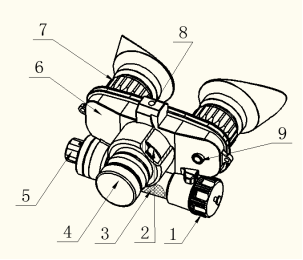
When You Still Need an Illuminator
Inside a cave, a windowless building, or dense canopy on a moonless night, even the best passive sensor may not have enough photons. In those cases, an external IR or white-light illuminator is still useful. The key difference is that the device itself is not dependent on one.
FAQ
Yes. Ultra-low-light digital night vision uses ambient visible light and sensitive CMOS sensors to form an image without an IR illuminator.
IR illuminators emit near-infrared light that can be detected by other night vision devices. Passive systems emit nothing.
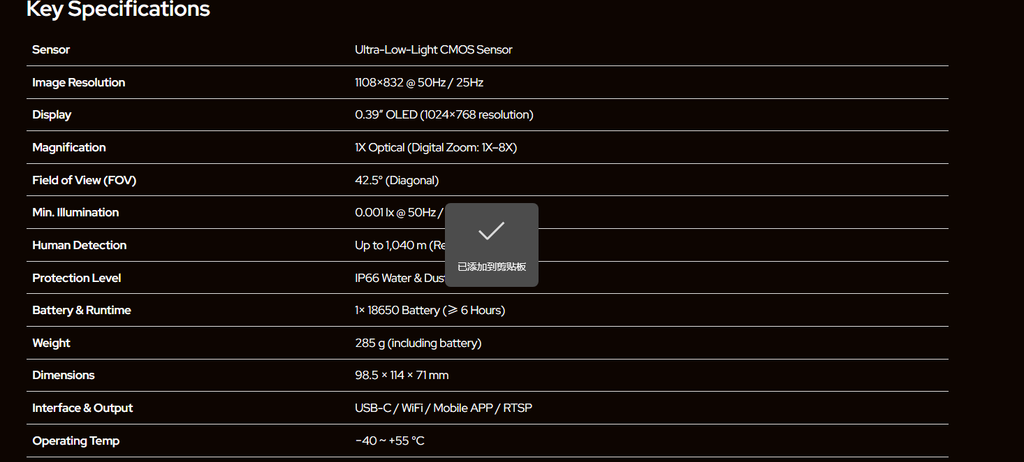
The NT-C11 can operate down to approximately 0.001 lux, which is roughly starlight-level illumination.
If the mission depends on staying dark, an illuminator is a liability you can remove. The NT-C11 is one of the devices designed around that constraint; the engineering team can talk through field-test conditions if you want a straight answer about your environment.