
Par le Dr Helena Voss, ingénieure principale en radiofréquences chez NavShield Global (15 ans d’expérience dans la protection PNT et la conception d’antennes adaptatives). Révision technique par l’équipe RF de NavShield.
Here’s the thing about picking a GNSS antenna—if you don’t check which bands it actually supports, you’re basically flying blind the moment someone turns on a jammer. Because a jammer doesn’t have to hit every frequency. It just needs to hit the one your antenna doesn’t cover.
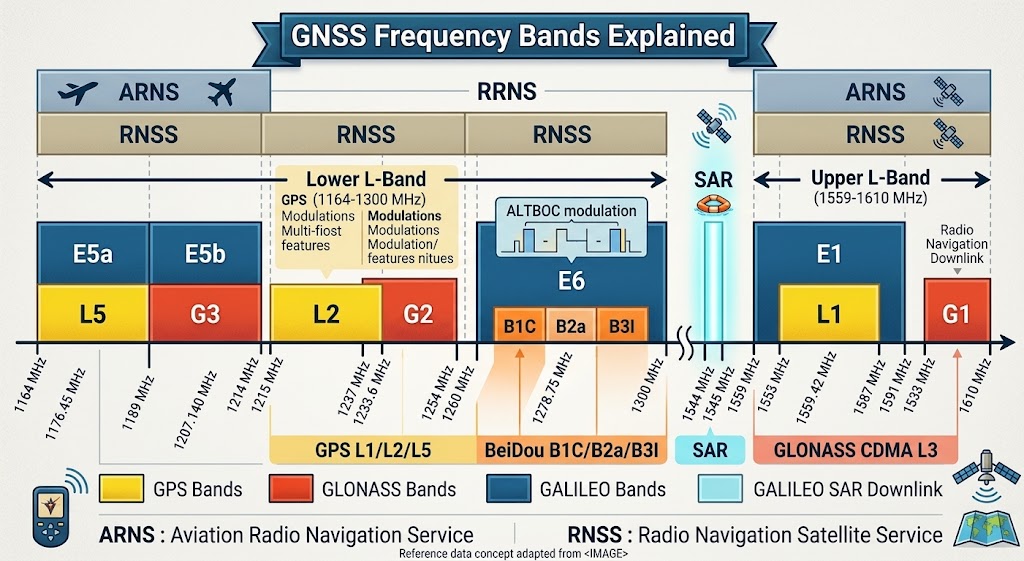
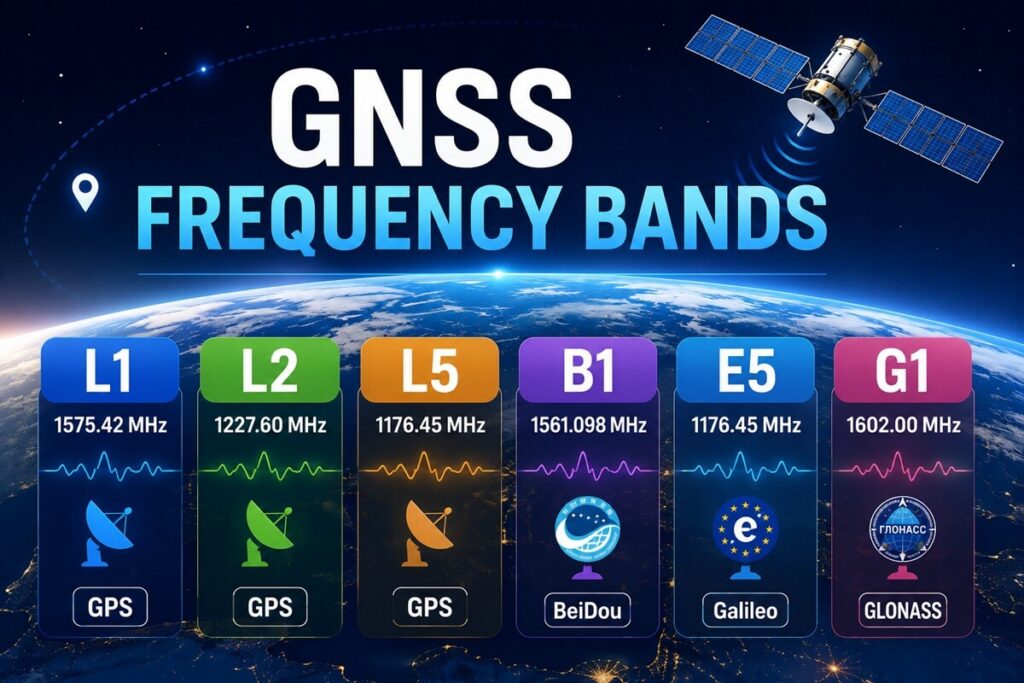
This guide maps every major civil GNSS frequency band—GPS L1/L2/L5, Galileo E5a/E5b, BeiDou B1C/B2a/B3I, and GLONASS G1/G2 plus the modern CDMA L3—and shows why your multi-band CRPA anti-jamming antenna must cover the exact bands your receiver tracks, especially against cross-band composite jamming. Browse the matching hardware on our CRPA antenna product page.
Once you know which bands matter for your setup, head over to our CRPA antenna product page to find the hardware that actually covers them.
Why Band Coverage Decides CRPA Survivability
Your Bandes de fréquences GNSS strategy should be driven by the jamming environment, not by marketing specs. Most buyers ask “how many elements?” before asking “which bands?” That order is backwards—a nulling antenna can only protect the signals it actually receives.
Antennes anti-brouillage
Frequency Diversity Is Not Spatial Nulling
A multi-band GNSS receiver using GPS + Galileo gains frequency diversity: two independent measurements of the same position. But diversity alone does not defeat interference. Under broadband or swept jamming, every band can be overwhelmed at once, and the receiver still loses lock.
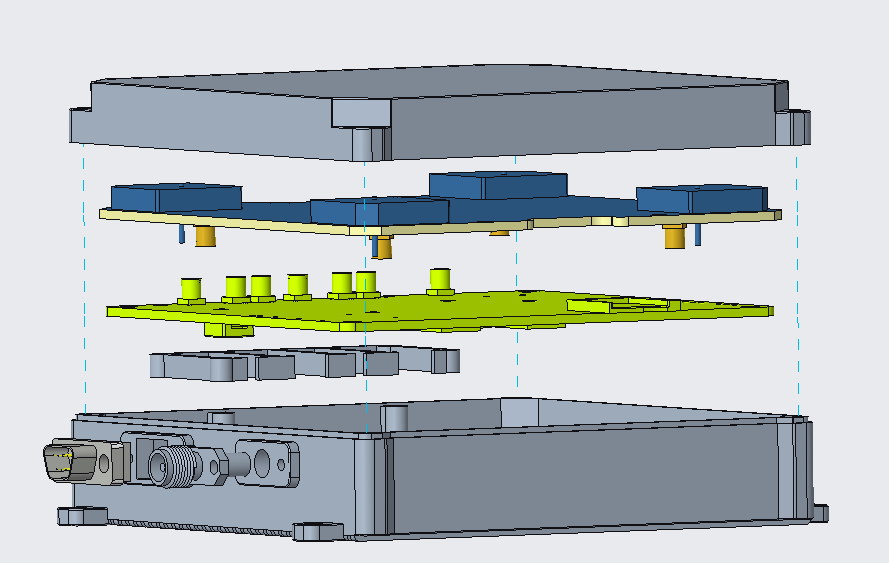
The real defense is spatial adaptive nulling: the antenna array estimates the interference direction and steers a deep null toward it in the spatial domain, physically suppressing the jammer while preserving satellite signals from other angles.
Single-Band vs. Multi-Band CRPA
This is the point procurement teams miss. An L1-only CRPA nulls interference on L1, but a jammer that also covers the receiver’s Galileo E5a or BeiDou B2a channel still blanks those signals.
- Single-band CRPA — cheaper, smaller; survives in-band jamming only.
- Multi-band CRPA (L1/L2/B1/B3) — nulls across several bands at once, giving genuine survival against composite, cross-band interference.
If your threat model includes wideband or multi-frequency jamming, band coverage—not element count—is the first spec to lock down. For background, see Qu'est-ce qu'une antenne CRPA ? et le fonctionnement de l'anti-brouillage GNSS.
GPS (USA) Frequency Bands
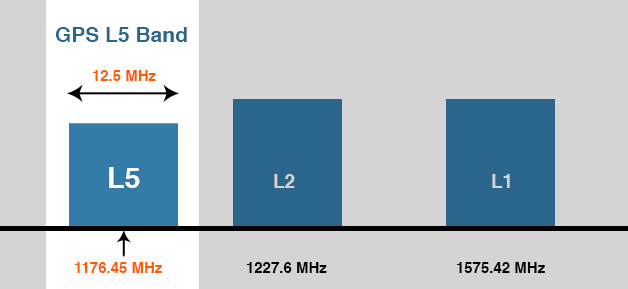
The GPS civil spectrum sits in the L-band. Three bands matter for receivers and antennas today—this is where the whole Bandes de fréquences GNSS map anchors, because L1/L5 align with BeiDou and Galileo:
| Band | Center (MHz) | Utilisation principale |
|---|---|---|
| L1 | 1575.42 | C/A, L1C — universal civil baseline |
| L2 | 1227.60 | L2C — dual-frequency civil |
| L5 | 1176.45 | Safety-of-life, aviation-grade |
Source : Programme américain de modernisation du GPS. Any Bandes de fréquences GNSS plan must start here before adding other constellations.
Galileo (EU): Don’t Treat E5 as One Band
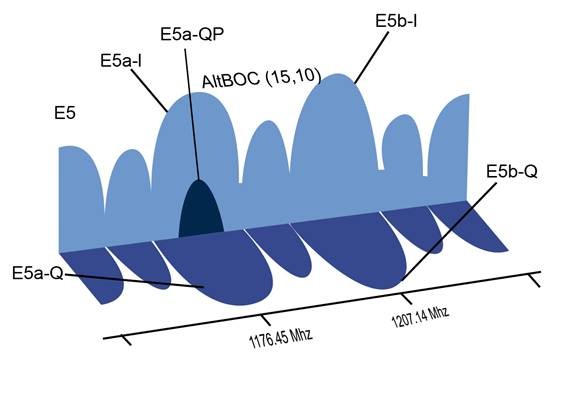
Galileo’s wideband E5 signal (1191.795 MHz, AltBOC) is normally specified as two narrower channels. Receiver and Bandes de fréquences GNSS datasheets almost always list them separately, and your antenna must state which it covers:
| Band | Center (MHz) | Remarque |
|---|---|---|
| E1 | 1575.42 | Aligned with GPS L1 |
| E5a | 1176.45 | Aligned with GPS L5 |
| E5b | 1207.14 | Pairs with E5a for dual-frequency |
| E6 | 1278.75 | Commercial / integrity services |
Source : Spécification du signal satellite Galileo (GSA). When a vendor says “covers E5,” ask whether that means E5a only or the full AltBOC—it changes your anti-jamming margin.
BeiDou (China): BDS-3 Modern Signals You Must Include
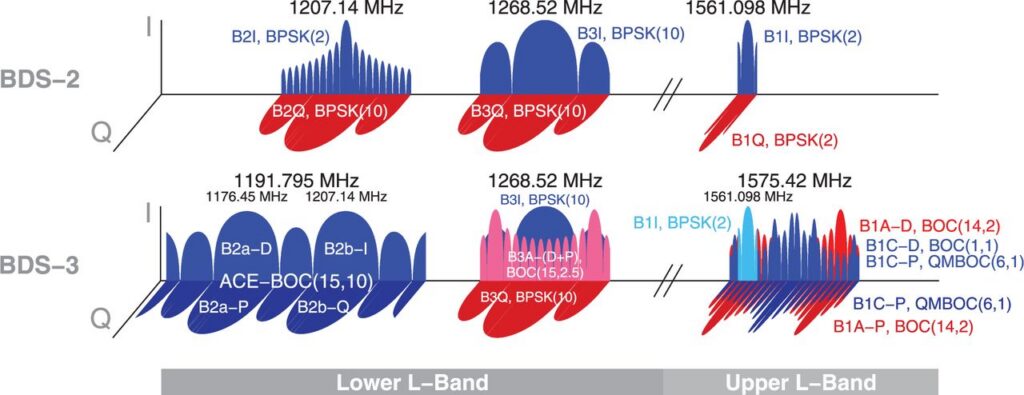
Legacy BDS-2 used B1I (1561.098) and B2I (1207.14). But global, interoperable BeiDou-3 (BDS-3) added signals that now dominate procurement—the BeiDou B1C B2a B3I triplet is the one spec sheets most often omit:
| Band | Center (MHz) | Significance |
|---|---|---|
| B1I | 1561.098 | Legacy BDS-2 civil |
| B1C | 1575.42 | BDS-3, aligned with GPS L1 / Galileo E1 |
| B2I | 1207.14 | Legacy BDS-2 |
| B2a | 1176.45 | BDS-3, aligned with GPS L5 / Galileo E5a |
| B3I | 1268.52 | Core signal for defense & high-precision users |
Source : China Satellite Navigation Office. Dropping BeiDou B1C B2a B3I is the most common spec gap we see, and B3I is essential for any high-precision or security-driven deployment operating in Asia.
GLONASS (Russia): FDMA Plus Modern CDMA
Traditional GLONASS uses FDMA on G1/G2. But modern satellites also broadcast GLONASS CDMA L3 signals that many multi-constellation receivers now track:
| Band | Center (MHz) | Mode |
|---|---|---|
| G1 | 1598–1605 | FDMA civil |
| G2 | 1242–1248 | FDMA civil |
| L3 (CDMA) | 1202.025 | Modern CDMA open signal |
Source : ISS Reshetnev / GLONASS. If your platform operates at high northern latitudes, GLONASS G1/G2 fill coverage gaps that GPS alone cannot—so your antenna must include them in its Bandes de fréquences GNSS coverage.
All Constellations at a Glance
This Bandes de fréquences GNSS comparison gives procurement teams a single reference for antenna selection:
| Système | Bands (MHz) | Interop Anchor |
|---|---|---|
| GPS | L1 1575.42 / L2 1227.60 / L5 1176.45 | L1, L5 |
| Galileo | E1 1575.42 / E5a 1176.45 / E5b 1207.14 / E6 1278.75 | E1, E5a |
| BeiDou | B1I 1561.10 / B1C 1575.42 / B2a 1176.45 / B3I 1268.52 | B1C, B2a |
| GLONASS | G1 1598–1605 / G2 1242–1248 / L3 1202.025 | G1, G2 |
How to Specify Antenna Band Coverage
Match the antenna to the receiver, then add margin for the threat. A clear Bandes de fréquences GNSS list from your receiver is the input; CRPA antenna band coverage is the output.
- Step 1 — List your receiver’s tracked bands. If it uses L1/L5 + B1C/B2a, your antenna must cover all four.
- Step 2 — Choose multi-band CRPA over single-band. Composite jamming spans bands; only multi-band nulling survives it.
- Step 3 — Confirm B3I if operating in Asia or high-precision contexts. Missing B3I means losing BeiDou under interference there.
Conclusion
The failure we see most often in real deployments isn’t a jammer overpowering a well-matched system. It’s a receiver tracking L1, L2, and L5 while the antenna only covers L1—and nobody catches the mismatch until the first interference event. The antenna simply doesn’t pass the bands the receiver needs, so the CRPA’s nulling engine has nothing to work with on those frequencies.
That’s why the procurement sequence matters. Start with your receiver’s band list. Then verify the antenna covers every one of those bands, not just the primary L1. A multi-band CRPA gives you the spatial nulling capability, but that capability only exists on the frequencies the antenna physically receives. Miss one band, and you’ve created a blind spot that jammers can and will exploit.
Element count gets a lot of attention, but band coverage is the more consequential spec. You can have eight elements and sophisticated beamforming, but if the antenna doesn’t cover L5 or B3I, those signals are gone under interference. Period.
For spoofing, treat it as a separate problem. CRPA handles the RF layer; you need a dedicated detector for the cyber layer. One doesn’t replace the other.
Mastering Bandes de fréquences GNSS is the foundation of PNT resilience. A correctly matched multi-band CRPA anti-jamming antenna—spanning GPS, Galileo, BeiDou, and GLONASS, with spatial adaptive nulling—keeps you positioned when single-band or diversity-only setups go dark. For spoofing threats that nulling alone cannot catch, pair it with our Détecteur anti-usurpation GNSS.