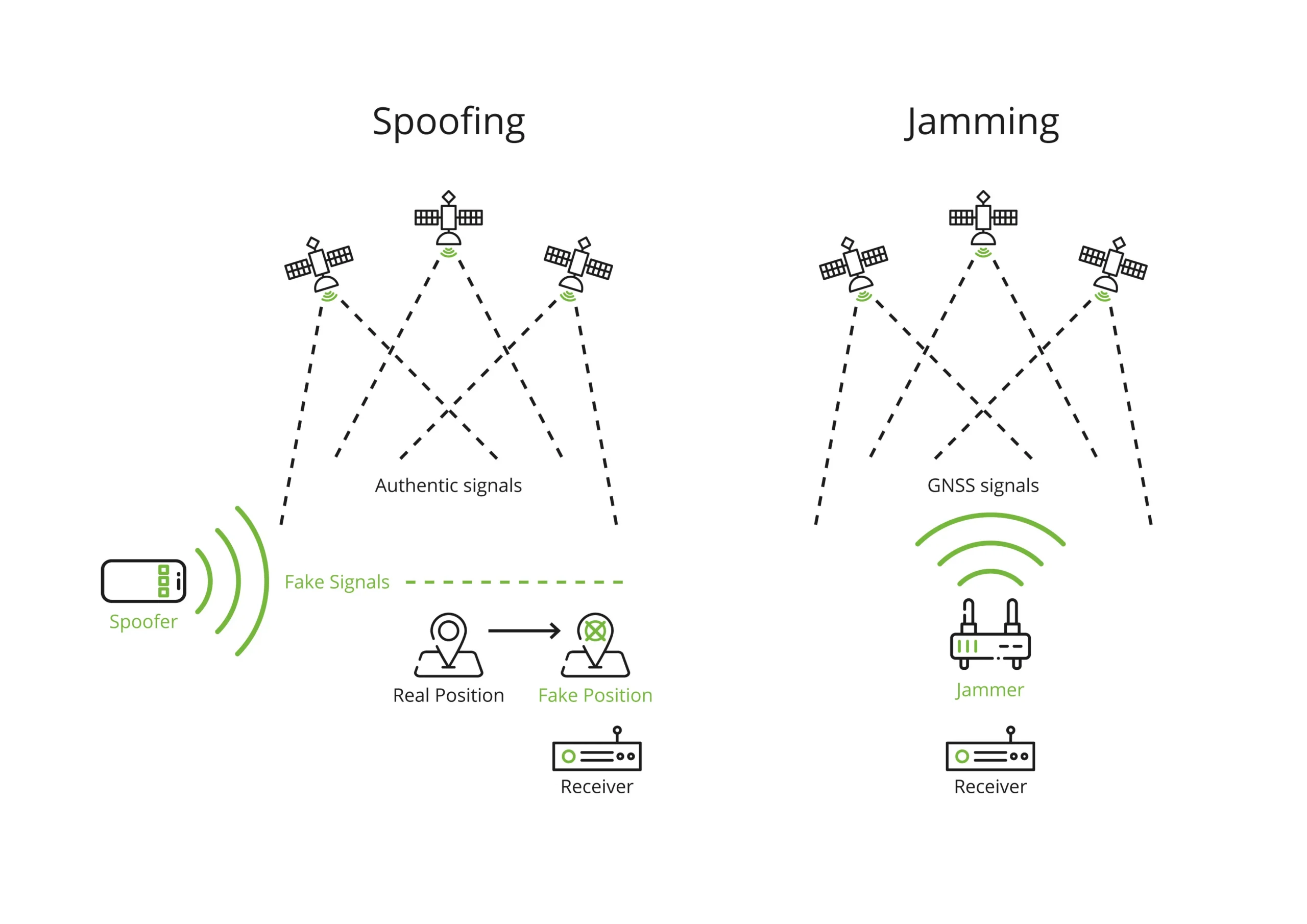
Anti-jamming and anti-spoofing are often grouped together, yet they serve entirely different purposes. One blocks RF noise at the antenna; the other verifies the authenticity of the signal data. Mistaking one for the other leaves critical platforms exposed to entirely different attack vectors.
Jamming is the brute-force denial of service—drowning the signal in noise. Spoofing is the silent hijacking of the receiver’s trust—feeding it false data that looks perfectly legitimate.
This guide dissects the differences, explains why you cannot rely on one to solve the other, and provides a decision framework to determine whether your specific mission requires both.
Recap: Jamming Denies, Spoofing Deceives
As covered in Brouillage GNSS vs usurpation d'identité GNSS, jamming blocks the signal and spoofing fakes it. Each needs a different mechanism: nulling for jamming, verification for spoofing.
Because the attack mechanisms differ so dramatically, each demands a completely distinct defense layer. Nulling at the antenna cannot cryptographically validate data; verification algorithms cannot block incoming noise. Understanding this separation is the first step toward building a truly resilient Assured-PNT stack.
What Anti-Jamming Covers
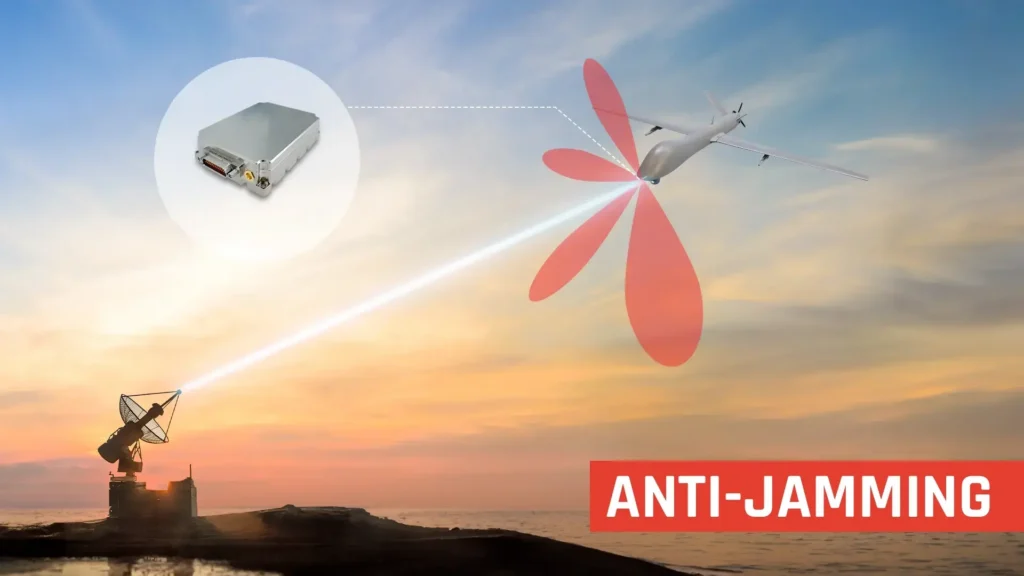
Typically via CRPA antennas and adaptive nulling, which suppress interference so the receiver keeps a fix. Essential anywhere jammers operate.
What It Does in Practice:
When a jammer activates, a standard receiver loses fix immediately. A system equipped with anti-jamming hardware maintains a continuous, stable PVT (Position, Velocity, Time) solution through the attack.
The Critical Boundary:
Anti-brouillage preserves signal availability. It ensures you have a link to space. However, it cannot tell you whether that link has been hijacked. If a spoofer transmits a signal that is stronger than the real one and comes from a direction within the antenna’s main receiving lobe, the CRPA will amplify it alongside the real signal. Therefore, anti-jamming is essential, but it is not a complete solution on its own.
What Anti-Spoofing Covers
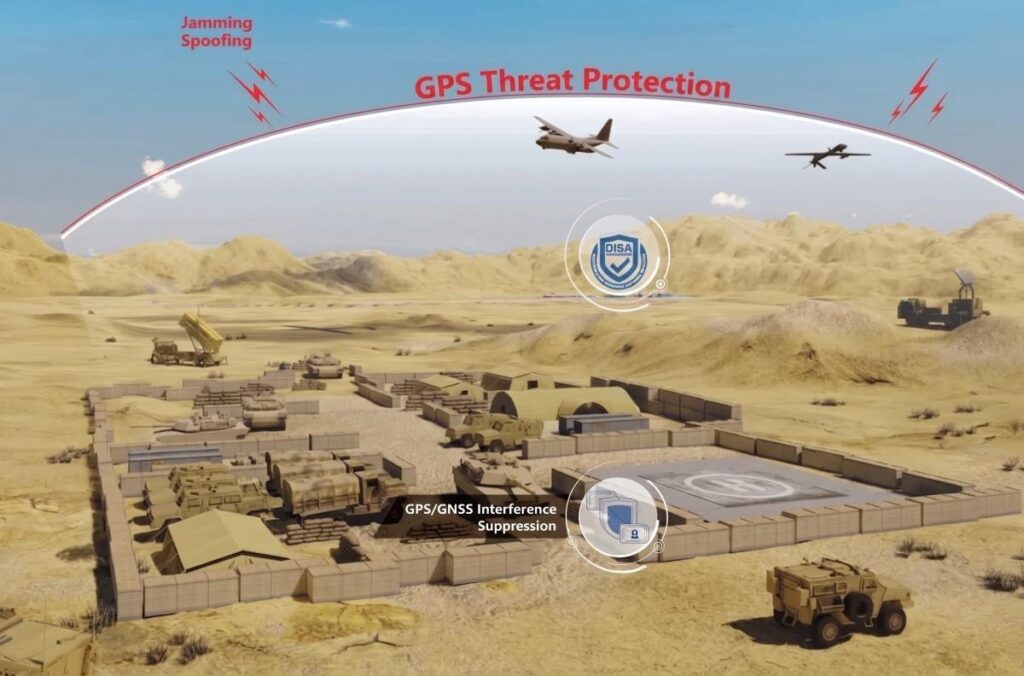
Verification that signals are genuine: cryptographic authentication (where supported), cross-checks against inertial and timing references, and anomaly detection. It stops an attacker from feeding you a false position even when the signal looks normal.
What It Does in Practice:
While a victim of spoofing may see a perfectly green “Lock” status on their screen, they are actually drifting off-course. A system with anti-spoofing hardware will detect the inconsistency, flag an alert, and refuse to feed the false data to the autopilot or navigation display. It preserves the integrity of the mission.
The Critical Boundary:
Lutte contre l'usurpation d'identité defends data integrity. It tells you what you are tracking is real. However, if the receiver is being bombarded by high-power broadband jamming, the cryptographic message never even arrives at the processor to be authenticated. Therefore, anti-spoofing cannot function without a basic layer of anti-jamming to keep the RF front-end clear.
Threat Model Table
| If your risk is… | You need |
|---|---|
| Lost fixes near cities / ports | Anti-jamming (nulling) |
| Wrong position near sensitive sites | Anti-spoofing (authentication + fusion) |
| Safety-critical navigation (aviation, maritime) | Les deux |
| Time/synchronization dependency | Anti-spoofing + holdover |
| Contested / conflict-adjacent operation | Both, integrated |
Do You Need Both? A Risk-Based Answer
- Commercial drone: start with compact nulling; add fusion as missions grow. Often sufficient without full authentication.
- Maritime: nulling for e-navigation; authentication strongly recommended given spoofing near busy waterways.
- Critical infrastructure: both—timing spoofing can break networks silently.
- Defense / government: both, integrated as assured PNT (see military systems mapping to commercial).
Integrated Assured-PNT Architecture
| Couche | Fonction |
|---|---|
| Antenna (CRPA) | Null jamming at RF front end |
| Récepteur | Track, authenticate, flag threats |
| Fusion (INS) | Validate and bridge outages |
| Management | Alarm, log, switch sources |
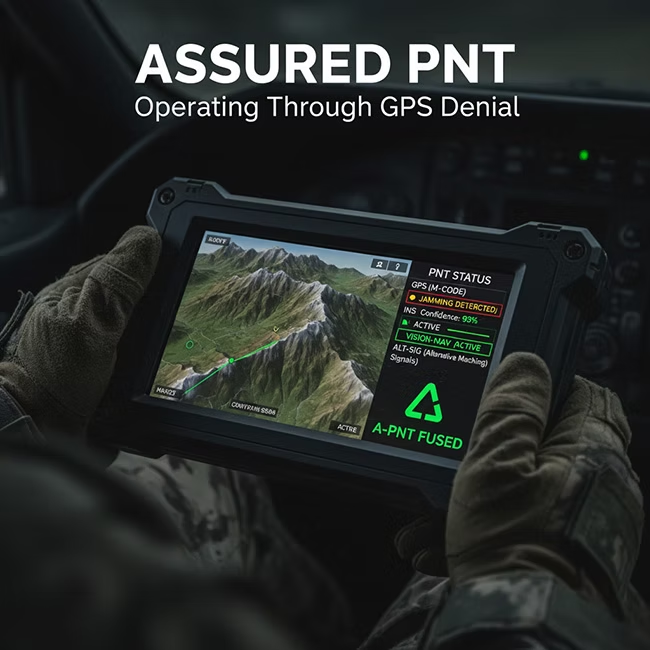
Cost and Complexity of Adding Spoofing Defense
CRPA hardware carries the main cost. Anti-spoofing is often added in processing (authentication, fusion) with less added hardware—so the marginal cost of “both” is usually lower than operators expect. Explore the techniques et hardware, ou contactez notre équipe for a tailored configuration.
FAQ
Q: Can one device do both?
A: Yes—integrated receivers pair nulling with spoofing detection in a single unit.
Q: Which is more expensive?
A: CRPA hardware dominates cost; anti-spoofing is often added in processing with less added hardware.
Q: Where is this restricted?
A: High-performance modules may require review—see conformité aux réglementations d’exportation.